Pages

4.14.2010

Tribal Activity Theory


In his book Network - Theorizing Knowledge Work, Clay Spunizzi introduced me to Activity Theory. I was previously familiar with Vygotsky's Zone of Proximal Development and some facets of dialectical materialism, but not their combination in Activity Theory. By contrasting that model with actor-network theory, I gained a far better grasp of ways I can use ANT in my projects.

One of those pursuits is applications of David Ronfeldt's TIMN framework to smaller scales than societal evolution. With that as my frame of reference, I've considered which of the Tribe, Institution, Market or Network phases that Activity Theory applies to. I've tentatively concluded there is a good fit with the Institution phase. That raised a question of how the Activity Theory triangle might get modified to fit a Tribal Activity Theory. I marked up a "Institutional" triangle in red to identify facets that do not fit tribal dynamics. Here's my summary of my modifications to arrive at a Tribal Activity Theory triangle.

When interpersonal communication was entirely oral, it's been widely argued that no one had a concept of being an individual separate from others or their surroundings. The identification with everything in their midst did not support causal, logical reasoning. Happenstance seemed to occur magically which engendered what we now label superstitions, irrationality and paranoia. There was no separate subject to observe, define or work toward an object of attention, desire, intention or pursuit. There would have been no sense of "mediational means" such as tools to use in hand or in mind.

Marshall McLuhan's studies of scholarly analyses of pre-literate cultures suggest there were no jobs to get done until print cultures came along. There was no division of labor or separate responsibilities. There were rituals to reenact that utilized weapons, headdresses, costumes and totems. But these were likely perceived as facets of the community, not as individual items, private property or separate responsibilities. Likewise, there were honor codes and traditions to maintain, but nothing was written down. Conformity was perpetuated with stories, threats of rejection and celebrations of traditions.

Mircea Eliade's research explored other facets of pre-literate cultures. He discovered that progress and the passage of time were regarded as profane, the opposite of sacred. The facets of life that seemed real where repetitious. They honored the ways the orbs in the sky and repeat of changing seasons maintained the myth of eternal return. They would not pursue objectives or deem it necessary to make improvements.

When print cultures emerged, it became possible for institutions to manage large locations, inventories, infrastructures, populations and borders. Technologies were developed to aid construction of buildings, roads, aqueducts and bridges. Tools enhanced the arts of defense, agriculture and governance. Putting "mediational means" at the top of the triangle makes perfect sense once technologies created a stream of dramatic improvements. Putting triangles into chains also fits the emphasis on linear progress "as the new sacred realm". Modeling advances as the result of resolving contradictions fits this technological progress against natural resources, other cultures and past traditions. Prior to those institutions, the tribe itself remained supreme among it's honorees. It was their means to survival and their protection from adversities. The community orchestrated the rituals to remain in the good graces of potentially avenging spirits. The community mediated everything that got done.

All this suggests how Tribal Activity Theory could model those tribal dynamics comprehensively with a simple triangle in spite of our current complexity and sophistication. Nowadays the conformity pressures of a tribal community would seem oppressive to most. We forget how unaware of exploitation the illiterate peasants were prior to Paulo Freire bringing literacy and liberation to their lives. The tribal freedom from production and schedule pressures may seem luxurious to us, but at a high cost in the array of technological advances we take for granted. We almost cannot conceive of getting mediated by an all powerful community of no individuals, separate interests or political strife.

When the community mediates all activities, everyone gets what they need to survive, multiply and reenact traditions. What needs doing gets done without job descriptions, policy requirements or managers. People play the essential parts as needed. What needs doing is routine and easily learned by imitating others who've been doing it repeatedly for as long as anyone can remember. The numbers are small so everyone is on a "first name basis" and accepted within the close knit community. The community mediates all the roles that fulfill the full array of timeless traditions. It's that simple.

4.13.2010

Mediated by transitory objects

I've recently been rereading parts of Marshal McLuhan's The Gutenberg Galaxy while I continue to integrate actor-network theory into my mental models. Here's how I've been able to articulate the intersection of those two great conceptualizations in my mind thus far.

There's a pervasive world we can perceive that seems reversible, impermanent and symmetrical. It captures our attention by flirting with us, alluring us and captivating us. It does not hold still or stay the same in other ways either. This world makes sense to us as a cacophony of sounds, a jumbled up bunch of aromas or a tantalizing combination of tastes. It does not require that we pay focused attention for long on one thing and thereby miss out on all the other attractions. This world invites us to take it all in and let most of it remain unexplainable. We use it and it uses us. We are observed and observing or getting read and reading. Objectivity is inconceivable in this relational world. We feel our actions are getting mediated by transitory objects.

There's a modern world we can perceive that seems irreversible and asymmetric. Things that appear do not disappear. We're predisposed to perceive this world of persistent objects when we're adept at reading texts. Strings of letters on pages or screens do not sway in the breeze, bend toward the sunlight, fly like the birds or grow off the page or shrivel up at night. Texts also do not make a sound, give off an odor or leave a taste in our mouths. They privilege our visual sense to reign supreme over all the other four or five senses. They help us see the arrangements of things as linear, causal, persistent and ordered just like lines of text on a page. We do the observing, analyzing or reading, and the evidence gets observed, analyzed or read. It's never the other way around that would compromise our objectivity, detachment and "realism". We assume actions are getting mediated by persistent objects.

Bruno Latour tells us "we were never modern". The pervasive world has remained available for
perceiving, interacting with, relating to and experiencing immersively. This world makes the modern world of visual dominance seem unreal. Objectivity appears to be a setup to trash the environment, exploit the pervasive world and feel unrelated to surroundings. The concepts to explain tools, technologies and progress seem self serving, inconsiderate, alienated and hostile.

This pervasive, never-modern world got a foot in the door of the modern world via electricity. Starting with the telegraph, phonograph and light bulb, we've begun to change our minds. While we were getting modernized by ink on paper and mediated by persistent objects, we acted strangely. We're now coming back to our senses. We're getting mediated by transitory objects like the baby bunny at my door. We're immersed in film, television, computer games, and messages on handhelds. We're making sense of all those instantaneous and transitory inputs like we were letting in all those sounds, smells and tastes. It seems like a constantly changing flux of flirtations that needs no big explanation, just lots of fascination and relations.

So I'm like "whatever" when some modern dude gets all strung out on explaining some specific change, like everything isn't always interchanging or what?

4.12.2010

Amassed at the border

In Network- Theorizing Knowledge Work, Clay Spinuzzi recognized a pattern at his research site where everyone in the organization appeared to be amassed at the border. The organization appeared to have "no interior" with so many employees devoted to the interfaces with outsiders. This image resonated with me deeply. My careers have been immersed in similar experiences. As a project engineer, I was coordinating my work with customers while keeping the production plant fed with the resulting documents. As a management consultant working in the clients premises so my time was devoted exclusively to their conflicted agendas. As an adjunct instructor for a local college, my time was spent with the students or for the students. That image of "no interior" fits perfectly.

As I reflected on other situations where this "amassed at the border with no interior" pattern might apply, I came up with the following list:
  1. brokerage outfits interacting with both buyers and sellers of investments, real estate, consignment goods or used vehicles
  2. local retailers serving customers with goods that have been negotiated with distributors, wholesalers or manufacturers
  3. field sales representatives interfacing with business customers and the home office, factory or sales support functions
  4. restaurant wait staff caught between their patrons seated at tables and the kitchen staff who are "up in arms"
  5. first responders always on call, dealing with victims, the endangering facets of their situation and the overloaded support services for the victims
  6. contractors on film projects, convention staging or touring companies who are required to coordinate their work on the fly
  7. design professionals caught between their clientele and the contractors who are building, assembling or installing the designs

Anyone in these situations would experience being a hub in a network with many incoming and outgoing linkages. Interactions would be chronically intense, demanding and consuming. There would be no timeouts to collect one's thoughts, regroup or change strategies. The pressures would preclude much concurrent documentation for later use. When pushed to keep a better record, frustrated replies would include "do you want the work or the paperwork?" Turnover of the most talented staff would remain high. Those that stick around would have learned to minimize their own initiative, curiosity and responsiveness in order to control the frenetic network of interactivity.

This "no interior" pattern contrasts with it's opposite where employees have gone into a huddle and never come out of the all-consuming interior. These personnel appear to always be in meetings, unable to return phone calls, incapable of making decisions on their own and under constant scrutiny by internal watchdogs. Their internal politics seem so tense and distracting that those who are expected to serve outsiders cannot: focus on the troublesome issue, take the time to reconsider it or get enough cooperation internally to respond resourcefully. Meanwhile, every internal move would get documented. Paperwork gets prioritized over actual work. Abstractions like "mission", "policy" or "reorganization" would be under constant review by standing committees. Outcomes would ultimately be delayed by the insular dynamics that appear so indifferent to outsiders.

I suspect the "all consuming interior" occurs when an organization seems "here to stay". This may result from a huge investment in a physical plant, a distribution system or a network of affiliates. The organization would get regarded as irreversible and asymmetric. There's "no way to pull the plug on the thing". It has exceptional staying power, consensus among diverse constituencies and interwoven dependencies on it. The enduring stability comes from the network encompassing it.

Then it fits that the "amassed at the border with no interior" pattern occurs when an organization is agreed to be an interim arrangement. Its days are numbered by changing economy, technologies, market rivals, scarce resources or fashion conscious consumers. For cadres of employees in this pattern, the end is imminent because it a limited scope project, a temporary assignment or a high turnover position. There is no incentive to invest in "interior functionality" under these provisional arrangements. Its investment in networking, alliances and outreach does not parlay into longevity. It lacks the staying power produced by a robust interior.

Finally, I wondered how there could be a "best of both" combination that avoided the perils of these two extremes. What if employees amassed at the border could:
  • occasionally retreat into a war room in person or online?
  • discuss with colleagues a visualization of the changing terrain, imminent threats, movement among rivals, and forthcoming invasions on the horizon?
  • formulate projects to prevent chronic problems, alleviate rework and improve anticipation of consequences?
  • projects could be tracked on a wall in person or online so individuals could maintain a sense of where things stand, how they could help others out or make recommendations on particular projects?
  • communities of practice met regularly to learn from each other, think out-loud about concerns and share solutions to problems that others could utilize?

When an enterprise implemented these approaches to "providing an interior", I believe the responsiveness "at the border" would be enhanced. These additional "actors" would mediate the actions of those employees to become less stressful, more collegial and better for the constituencies in the long run. The impression on outsiders would change from "passing ships in the night" to "enduring organizations that offer exceptional service". In other words, the best from a balance of reaching across the border and coming inside for a change.

4.09.2010

Caught in the crossfire


Activity theorists and actor-network theorists have been sniping at each other. They been saying "no" to each other's position. In his book: Network- Theorizing Knowledge Work, Clay Spinuzzi placed himself in their crossfire and said "yes" to both positions. He found common ground between the two positions as well as valuable ways they differ. Rather than invalidate their differences, he found uses for them like a practicing pragmatist. Rather than indulge in a reductionism of their positions to simplify their attacks on each other, he allowed for each to be complex and multifaceted. Blessed are the peacemakers.

Actor-network theorists have been caught in a different crossfire between modernism and post-modernism. While those two positions have been saying "no" to each other, Bruno Latour has gotten in the middle and said "no" to both. Rather than identifying common ground, he has defined a third position that refutes both of the others as lacking realism. Both added layers of conceptual baggage which obscure the flat reality of subtle tracings, changing alliances, reversible agreements and symmetric interactions. Latour restores innocence, wonder and fascination with each immediate occasion. Blessed are the meek.

As I've entertained both of these strategies in my mind, I've been to see a pattern to the variety "interstitial arguments". Here's the possible framework for considering our options when caught in the crossfire of opposing positions:
  • It's possible the positions remain opposed because they occur in a causal or developmental sequence. One leads to the other, provides preliminary "sedimentation" or lays the groundwork for the other to follow. Then it can be argued the two are different phases, stages or developments of a shared process. Acorns and oak trees cannot be the same size, enact the same growth patterns or relate to other trees in the same ways.
  • It's possible the positions remain opposed because they need each other as rivals, enemies or missing halves. Together they form vicious which go round endlessly. They perpetuate dramas of reacting to each other's prior reactions in order to compensate for each other's shortcomings. Then it can be argued there is no end in sight until the need for each other enters into the squabbling and exposes the perpetual uses made of the disagreements.
  • It's possible the positions remain opposed because they need to be redeemed by an outsider position. Both lack the perspective to recognize interaction patterns, possible exit strategies or reversals of single-minded pursuits. Then it can be argued that it takes both to achieve the overall effect as if they are two sides of one coin or two ingredients in one concoction.
  • It's possible the positions remain opposed because it's time for a transformation. Both positions are constituents of the emergent disintegration which is getting replaced or facing it's imminent extinction. Then it can be argued the two have taught us how to experience the "worst of both" alternatives while we're learning how to realize the "best of both" paradoxically.

A framework like this changes how we problematize getting caught in the crossfire. Our actions are mediated by these possibilities to become more pragmatic and strategic. Our effects on the opposing positions will be improved. We will have argued effectively for different definitions of positions, players and interactions.

4.08.2010

Network - Theorizing Knowledge Work


Yesterday I finished reading Clay Spinuzzi's latest book: Network - Theorizing Knowledge Work in Telecommunications. Last night I brainstormed insights I gleaned from the book that I want to explore further here. I usually get between six and ten ideas from a good book. My list from reading Clay's book has 21 items on it. What a treasure trove of inspirations I've found!

I learned of Clay's work a few weeks back from an email that pointed out his review of The Firm as a Collaborative Community. I had written seven blog posts last year on my comprehensive review of that book. As I explored Clay's blog archive, I discovered he values David Ronfeldt's TIMN and Netwar models that I've explored here. He's been reflecting deeply on Bruno Latour's and John Law's: Actor Network Theory which I've read two books about so far. His research for the book delved in a phone service provider that reminded me of some of my management consulting circa 1988, shortly after the breakup of the Bell System. Clay is thinking rhetoric is changing as the explosion of connectivity impacts work styles and forms of organization. The reviews of his book on Amazon celebrate his search for common ground between Activity Theory and Actor Network Theory. All that clarified my interest in reading his book. I was not disappointed.

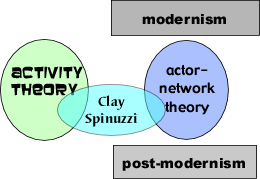
As the diagram shows, I've been anticipating many different overlaps between Actor Network Theory (ANT) and my many interests. Clay's extensive reading, combined with his rhetorical skills has made ANT far more accessible than it seemed to me last year. His book is functioning as an intermediary in my pursuit of making more connections to ANT. It can be said that ANT has been transformed in my experience and I've been changed too. I had previously been defined as someone who has difficulty grasping ANT in spite of my anticipation of it's applicability. I am now defined as someone who has more access to ANT's insights. As I continue to translate ANT and Clay's own insights into my pursuits, both ANT and Clay will become more real. Stay tuned.

4.07.2010

Getting used by our tools

We use our tools and our tools use us. Our actions get mediated by the tools we use. Our tools get mediated by those users of the tools. The effects our tools have on our minds, efforts and outcomes results from the combination of our using our tools and our tools using us.

If our relationships with tools were unilateral, we could use them without being affected by them. We could safely assume we had not adopted the outlooks, sensibilities and premises of a tool by using it. We could delude ourselves into an asymmetrical view of being superior to our tools, in control of our technologies and responsible for their effects.

If our tools relationships with us were unilateral, they could get used by us without getting misused, overused, under-utilized or abused. They could perform without getting handled, applied, interpreted or deployed creatively. They could maintain an asymmetrical picture of being extremely reliable, rational and predictable while we were being unreliable, moody and impulsive.

Our relationships with tools are symmetrical. We reciprocate, accommodate and cooperate beyond reason. We define them and they define us. They meet our needs and we adapt to their requirements. When we don't meet their needs, they don't meet ours. They teach us to comply with their wishes in order for them to comply with ours.

We think about how to use our tools and they're designed with thought about how we will use them. When we think differently than the thought that when into them, we end up with better or worse results. When we fail to think about using them, they can use us without thinking. We become slaves to the machine, pawns in the mechanistic game or tools for others use. When we're wise to this symmetry, we can use our tools to make a difference and make new tools to make a different difference. We become effective and creative just like our tools.

4.06.2010

Where we find the motivation?

Having reflected more deeply on all I've recently learned about our varieties of personal motivation, I'm now seeing a pattern in it all. It seems we find the necessary motivation in different ways depending on the situation. Here's a brief look at that pattern:

  1. When we're living in desperate situations, we call upon our instincts to take the necessary actions. We may be living on the street like the homeless and runaways, in a war zone or failed state or even living in the wilderness. In each case, we will be driven by our survival instincts. We'll feel the urges to do whatever keeps us fed, watered and rested. We also get energized by our herding instinct which seeks safety in numbers when ganging up on others or providing us protection from dangers. Our mating instincts will increase the population for the sake of safety and continuity.
  2. When we're living in stabilized situations, we rely on extrinsic rewards to take the required actions. We may inhabit a cubicle in a big enterprise or work station in a factory. We may own some property and vehicles. We may also keep a full schedule of familiar routines. We do what we're told to do by higher ups, policies or legal systems. We do what we're obligated to do by others relying on us. We comply with requests that pay us to put out the effort. We dismiss those temptations that get penalized severely. We look for ways to cheat and game the system so we get rewarded for less effort or escape the punishment for indulging in a temptation. We make ourselves do what needs has to get done, since our self motivation has been compromised.
  3. When we're living in competitive situations, we rely on our intrinsic motivation to make the extra effort. The chance to excel in comparison to rivals fuels our self motivation to do our best. The set-up to prove to ourselves how good we can become inspires us to take on new challenges. We're motivated to take initiative, stretch ourselves and explore new possibilities. With so much inner drive, we're likely to be overworked and underpaid. Like starving artists, we'll receive much praise and little compensation for our excellence. We'll get taken advantage of for our generosity, willingness to take initiative and sense of responsibility to see things through to completion. We'll make the sacrifice of extrinsic rewards to follow our intrinsic motivations to our heart's content.
  4. When we're living in collaborative situations, we realize the best of every kind of drive in us. We do what we feel like doing because that's how we do our best, get creative about problems and provide the most benefit to others. We receive more than enough extrinsic rewards to prevent them from becoming an issue, distraction or deterrent to self motivation. We find our herding instincts get deeply satisfied by the dynamics of collaboration making compatibility, safety and sustainability a reality. We develop a strong sense of rectitude which preempts any inclinations to cheat, take advantage of others or profit at others' expense.
With this pattern in mind, it seems to me we're equipped with the right kind of drives for every situation we might encounter. When we have motivation problems, we're failing to call upon the appropriate kind of motivation within us. When we're experiencing a flow state, we're finding the right kind of motivation we need for the situation.

4.05.2010

Disdain for questioning authority


Alfie Kohn has written many books about problems in education that tie into the effects of extrinsic motivation in. Like myself, he advocates students thinking for themselves, finding their own motivation and questioning authority. Those of us who encourage each student's independence from authoritative sources will hear complaints from learners like "please don't make me think" or "just teach us what will be on the test". In his essay: Challenging Students... And How to Have More of Them, Kohn relays his own experience:
As a brand-new high school teacher some years ago, I resolved to let my students know that this passivity was not what I was looking for. On my very first day, I proudly — and, given the culture of the school, somewhat defiantly — pinned a yellow button to my shirt that said QUESTION AUTHORITY. Alas, this concept was so unfamiliar to the students that some of them assumed the phrase was a descriptive label rather than an exhortation. One girl wanted to know who had appointed me the school’s question authority.
I'm currently reading a new book: The Art of Choosing by Sheena Iyengar. Her research reveals a wonderful reason for this inability to question authority. She has found that many cultures are founded upon the premise that everything works out for the better when others make choices for us. These cultures arrange marriages for their offspring. They set up the parental figures as authority figures that dictate the conduct of children and less privileged adults. They instill a sense of duty toward and respect of elders. They cultivate dependence on others choices, rather than independence to make one's own choices. Consensus and conformity are far more important than self fulfillment or self expression in these cultures.

Iynegar's research also discovered that a few cultures do not fit this pattern: notably the Brits Aussies and Yankees. We want to make choices for ourselves. We lose motivation, dedication and creativity when others impose their choices on us. We are predisposed to question authority because we are becoming authorities ourselves. We get raised and socialized to become independent, individualized and intrinsically motivated. We assume everything will work out better when everyone is free to explore and express themselves.

I question whether this disdain for questioning authority fits entire cultures. Just as teachers find the consensus/dependence culture in Anglo classrooms, management consultants find it in executive board rooms. It appears prevalent to me in gangs, cults and religious communities. So the applicability of her findings may not be applied as broadly as she proposes, but it has been eye opening for me to realize that large percentages of the global population want others to choose for them.

4.02.2010

Driving on a full tank


Dan Pink's latest book, Drive: The surprising truth about what motivates us, builds on some great ideas from four other books worth reading. Each of these other authors give us advice for driving on a full tank of our own energy. Here's how I'd paraphrase each of these other books' inputs into our thinking about extrinsic and intrinsic motivation.

Flow - The Psychology of Optimal Experience / Mihaly Csikszentmihalyi Whenever we're anxiety ridden about what we're trying to make ourselves accomplish, we going against the flow. We're turning life into a struggle and getting tunnel-visioned out of our frustration with the difficulties. We're already maxed out on the existing challenges and freak out in the face of additional obstacles. We're relying on those "carrots on the table" to get us fired up in order to get through this,. There never seems to be enough carrots.
--- When our body-minds are equally serene and energized, our powers of observation increase. We not only see more, we sense when to respond in ways that turn out to be "spot on". We feel like we're connected with the others involved and any changes unfolding. We welcome more challenges because we're handling them stress-free in this "flow" state of mind. We're feeling blessed by the experience which amounts to receiving an abundance of intrinsic rewards in the moment.

Mindset the New Psychology of Success / Carol Dweck When we think our amount of intelligence is a given learning is something we try to avoid. Anytime we're struggling with comprehension or execution, we think we're exposing our deficient amount of intelligence. It can only be bad to make mistakes and there's no sense in taking risks that could result in blatant blunders. The only way we can get motivated to learn is from the grades and fulfillment of requirements that lead to graduation. The "grade and grad" game is the only game that can be won with fixed amount of intelligence.
--- When we think our intelligence grows as we learn more, learning is inherently rewarding. Struggling to accurately comprehend or execute new understandings will be rewarded with the successful accomplishment. Mistakes are part of the process that help to fine tune approaches and to clear up mistaken assumptions. The greater the risk taken, the greater the reward realized as the result adds to personal confidence, expanded curiosity and deepening satisfaction with the self-motivated exploration.

Why Work Sucks and How to Fix It: No Schedules, No Meetings, No Joke -- the Simple Change That Can Make Your Job Terrific / Cali Ressler & Jody Thompson When we work in a place where we're getting managed, we're obligated to comply with commands, structure and policies. The use of our time is left to other's discretion since we're being paid to show up. We think work is a place we go to, not something we do. We become dependent on the pay and perks to appear dedicated, willing and eager to perform on the job. Meanwhile we're paying a high price in relationships, personal interests and self respect. We may occasionally let our resentment show, but we mostly repress it because "we know what's good for us".
--- When we work in a "results only work environment" (ROWE) how we get a job done is our responsibility. We're given the freedom to work from home, on the road or at odd hours. There's no need to show up for boring meetings since all communications can be handled via cell phones, PDA's and laptops. This approach goes far beyond flex time or employee empowerment. It restores the ability of individuals to do their best work when respected, trusted and admired for getting it done as they see fit. Self motivation soars with resulting increases in coordination, cooperation, communication and commitment.

Predictably Irrational: The Hidden Forces That Shape Our Decisions / Dan Ariely When we're operating under market norms, we're available for a price. We wonder what others will cost us to cooperate with our intentions. We assume they can be bought like ourselves. We will seek a fair price while becoming vulnerable to irrational comparisons. We'll have no concept of cheapening the relationship or reducing others' genuine initiative to our successful manipulation of their incentives.
--- When we're operating under social norms, we do things out of the goodness of our heart, consideration for others and our genuine commitment to the common good. We express our self respect through what we do for others in respect for their needs, outlooks and limitations. We take offense when someone introduces market norms while we're happily self motivated, generous and satisfied.

4.01.2010

Use it or lose it


One of my favorite principles of effective instructional design has always been "use it or lose it". When we fail to use something we presume we have already learned, it's not there when we need it later. We forgot it because it seemed useless at the time we were exposed to it. Much like a library that pitches the books that no one has checked out for a decade, our long term memory acts as if cognitive housekeeping is routinely required.

Use if or lose it also applies to cramming for tests. The immediate use of the new knowledge involves coming up with it under test anxiety in order to get a good grade with it. Our minds can handle those short term uses on the basis of usefulness, just like they approach long term retention. However, that cramming use is obviously temporary and the knowledge is soon forgotten. College students agonize when it gets announced the the final exam will cover the entire semester, not just the second half. They've just become aware that all that "useless" stuff from 6 weeks ago is going to be useful for another crucial hour during the final week of class.

Learning by doing, praxis or social interaction is a different story. The "context of use" is immediate. The value in knowing it is evident and convincing. When that practiced use gets reapplied in another situation, retention is effortless and enduring. There's no cramming required. Our memories work superbly. We've learned the way that works for our minds, our conduct and our reputation.

This principle implies that instructional design ought to create "contexts of use" rather than contexts of informative content delivery, required reading or contrived memorization. It's much more difficult to create situations where the information gets used when starting from a bunch of expertise to deliver. It's much easier when starting with problems to solve, crises to alleviate or conflicts to resolve. Then the content will either be presented as tools or deleted because it's not applicable to those use cases. Then use it or lose it applies to editing the content of an instructional design, not just the retention strategy of the participants.

3.31.2010

Heralding post print literacy


This week I've been exploring Prezi software and pondering its implications on our uses of words. It appears perfect to me for heralding in post print literacy.

3.30.2010

Deploying strategic lenses

Whenever we're thinking about making a change, making an impact or making progress, it's time to look at our challenge through strategic lenses. If we take the situation literally, at face value or superficially, we're likely to function as our own worst enemy. Poor strategic judgment is the result of a failure to see what is hidden, subtle and unstated. Strategic lenses correct that deficiency by questioning our choice of perceptions.

1. Strategic outlook or tactical fixation? When we're seeing our situation strategically, we combine a panoramic overview with focused attention. We get the big picture and the particulars of the detailed situation. We remember the purpose/mission of our intervention while getting down to the task at hand.
----- When we're suffering from tactical fixation, we've lost sight of the mission, big picture and access to alternative maneuvers. We're trapped by our attention to details, fear of getting distracted and obsession with being right about the obvious evidence. We dwell on the details and miss the opportunities to outmaneuver the opposition.

2. Direct or indirect strategy? When we see a process to trust and nurture, we feel we can take an indirect approach. We create demand, hunger, appetite or urges in others. We get them to sell themselves on what we're selling instead of giving them a sales pitch. We let go of making the results happen and allow the desired outcome to come around on its own.
----- When we're oblivious to any trustworthy process, we're left with no alternative but to take a direct approach. We become pushy, persistent and obnoxious to make things happen. We expect to succeed by forcing the issue, overcoming objections and intimidating the opposition.

3. Strategic or literal weakness? When we realize how strengths can backfire, bait attacks or slow down our own maneuvers, we see the benefits of weakness. We sense the wisdom in appearing to be a work in progress than a finished work of art. We suspect we're indulging in overconfidence, hubris and conceited outlooks when we think we're strong, better or invulnerable. We look for the flip-side of each presumed strength for its inherent weakness, failing or shortcoming.
----- When we take our strengths literally, we're afraid of appearing weak. We come on too strong, make enemies of potential allies and overstep our bounds. We don't know when to back off because it's inconceivable how that could be a show of hidden strength rather than an obvious admission of defeat, inferiority or vulnerability.

4. Strategic emptiness or fullness? When we're observant of how our minds function under pressure, we see the wisdom in increasing innocence. We favor our mental resources for questioning the obvious and becoming fascinated with unforeseen possibilities. We challenge our predictions for what always happens, never occurs and cannot come about. We see how to take advantage of others presumptions to play them for the fool.
----- When we're afraid of how our minds sabotage our over-zealous ambitions, we regard innocence as dangerous vulnerability. We favor our mental resources for aggression, conviction and endurance. We become full of ourselves and easily baited by others' shows of weakness, vulnerability and ignorance. We keep up our own confidence at all cost rather than shatter our preconceptions with a reality check.

When we look at a situation through all these strategic lenses, we'll get a very different sense of what to do. We derail our tendency to jump to conclusions. We give ourselves more to reflect upon and consider from several different angles.

3.29.2010

TIMN applied to school governance

In recent weeks, I've left a few comments about the TIMN framework on David Ronfeldt's blog: Visions from Two Theories. Yesterday, I was discussing with a friend how TIMN could be applied to revising the governance of schools that is a facet of the current Race to the Top competition in the US. If you've followed my previous explorations of the TIMN framework, you know me to be very process oriented and eager to apply David's macro scale analysis (social evolution) to micro scales of psychological states and stages of single enterprise evolution.

My latest thinking has also been helped along by Philip Blond's essay last month in the UK's Prospect Magazine: Rise of the red Tories. He suggests that we've ended up worse off as a society from the expansion of big corporations and big governments (in the UK and the US) via too much individualism. Like the blogs of Michel Bauwens, John Robb and Jeff Vail, Blond foresees a migration toward communitarianism where small, self-governing communities thrive on the diverse contributions of local participants. I got the the idea from his analysis of excessive individualism that private enterprises in a Market could progress toward a collaborative, "Main Street" economy or regress into those "too big to fail" global corporations that function like Institutions. This helped me define the potentially progressive (M -> N) and regressive (M -> I) patterns for the M in the TIMN framework through my "process biased" lens. I then applied this perspective to the governance of schools, which looks like this:

  • Tribal school governance leaves each educational issue for every tribe to resolve by itself. There would be a lack of infrastructure like educational materials, curriculum development and teacher training. A teacher would emerge from the collective gathering as one resourceful enough to improvise amidst transient or sparse conditions. There would be very controlling legacy traditions to compensate for the tribe's inability to better serve those in need of an education. Those who respected those confining traditions would be honored while others' disrespect of them would be taken as dishonor to the entire tribe.
  • Institutional school governance replaces honored traditions with uniform policy compliance. Hierarchies of administrators would provide massive infrastructure to ensure quality in spite of incompetent or under-qualified instructors. Exceptional educators would go unrecognized to avoid "playing favorites" or stirring up resentment among the less fortunate. The system would provide uniform materials, instruction and testing to compare individual students to established norms. Everyone would be expected to meet established standards or endure the stigma of deviant, defective or deficient qualifications.
  • Market school governance opens those closed compliance systems and invites individual innovations. Emphasis shifts from uniformity to customization of services via flattened, democratic and discretionary administrative practices. Individual students get regarded as one-of-a-kind opportunities to identify special needs, work with exceptional abilities and remediate personal shortcomings. Likewise, educators would be differentiated and valued for their unique contributions. Everyone would be expected to cultivate their talents, expressiveness and viewpoint. Performance and productions could on be evaluated subjectively, as an added dimension of feedback to supplement the actual outcomes, peers' responses and self-critiques.
  • Networks school governance assumes every participant in the educational system is connected within and outside the system. Students are interconnected via social networking platforms and handheld technologies. Teachers are connected to other teachers across school and district lines as if "not invented here" no longer applies to the kinds of problems and solutions under consideration. Administrators would experience every day offering the value of "professional conferences" as they could easily tap into their network for advice, perspectives and encouragement. All this connectedness also implicates each participant as a contributor, responder and reciprocator. Everyone would spend lots of time each day keeping the conversations going within their personal networks. The prior concept of "valid educational activity" would drift from formal instructional practices to this vast array of informal explorations, contributions and collaborative realizations.
There's a pattern of regression in the long history of failed educational reforms. Breakout approaches to education innovation appear to get off to a great start. They fit the pattern of "market school governance" I detailed above. Yet, over the years, they migrate from open to closed, diverse to uniform, and distributed to centralized administrative controls. In short they regress from Market forms of school governance to Institutional forms. The advent of social networking at a global scale suggests to me that we could enter a new era of successful enduring educational reforms. Adopting the Network form of school governance could bring about that change.

3.26.2010

From losing out to dropping out

A large number of newly hatched educators drop out of the teaching profession every year. An even larger number of high school and college students drop out before graduation. This morning I've been exploring the possibility of a gradual process building up enough frustrations to culminate in dropping out regardless of age or maturity. The process starts with losing out, followed by acting out which leads to burning out which ends up with dropping out. This process applies equally to teachers and students. The consequences of closed minds, extrinsic rewards and linear delivery systems play no favorites.
  • Losing out: When receiving formal evaluations of performance that determine the amount of reward, intrinsic motivations go into hiding. It does not matter whether the rewards impacted by the evaluation are points on a quiz or the size of a pay raise. The person framed by contingent rewards no longer gets in the mood to do anything and can only force themselves to show up. They stop getting creative ideas, empathic insights into others or inspired alternatives to solve chronic problems. They lose out big time.
  • Acting out: After the loss occurs, a bounty of negative emotions arise. There's anxiety about the loss and suspicions of personal inadequacies. There's lots of resentment toward the authority figures to dish out those supposedly objective evaluations. There's frustrations with how much of the required activities seem contrived, useless and senseless. Finally, the inner turmoil gets acted out as misdirected anger, retaliatory hostilities or other forms of taking one's own frustrations out on others.
  • Burning out: The cathartic experiences of acting out only provide temporary relief. There is a concurrent loss of stamina, endurance and motivation. those who've passed through phases of losing out and acting out become more passive, dependent on others and incapable of personal initiative. Feeling numb, bored and indifferent leads to acting bored, apathetic and indifferent. Commitments seem annoying. Requests seem like impositions. Conversations seem excessive. Burnout has replaced acting out.
  • Dropping out: The situation calls for a "fight or flight" response. The pervasiveness of the adversity seems far too extensive to fight it. Nearly everyone appears to be content with feeding the problem, perpetuating the abuses and ignoring the effects on individuals. It's taken for granted that participants would lose out, act out and burn out. Everyone is looking at what's going on with closed minds. The only solution is to get out of the toxic system. It seems like the open-minded thing to do that may possibly revive intrinsic motivations and self respect.
The dropouts' assessment of the problem appears accurate to me. There's no solution at the level of changing job/course requirements, pay/grades rewards or counseling/advising interventions. The system needs to replace uniform requirements with self-selected explorations, extrinsic with intrinsic rewards and content delivery with peer reciprocation systems that will open closed minds.

3.25.2010

Emotions vs. feelings

One of the many reasons we keep our minds closed is to keep a lid on our emotional turmoil. We've had bad experiences of our uncontrollable outbursts which teach us to suppress those urges diligently. These experiences give our irrational side a bad name. We assume anything that is not logical has to be problematic and in need of control. We pride ourselves in being rational at great expense to our intrinsic motivation, empathy for others and personal creativity. We assume self discipline and self control are viable solutions. We don't realize we've gotten out of touch with our feelings just like zombies, ice queens and robots make so obvious to us.

Feelings are very different experiences from our emotions. Emotions are irrational in ways are are incompatible with rationality. Feelings make tons of sense and add a deeper dimension to our logical reasoning. Emotions arise from our primitive limbic system in ways that hijack our thinking mind. Feelings come more from our right brain where we receive inspirations, inner guidance and panoramic awareness of situations. Emotions are a problem that accompanies closed minds. Feelings are solutions which come to open minds. Feelings give our irrational side a good name.

We're in touch with our feelings whenever we:
  • bask the beauty, blessings and good fortune of the scene out the window or before us outdoors
  • get a sense of the best time to do something to have the best effect
  • experience a harmless connection to particular animals or plant life
  • happen to be "in the right place at the right time"
  • lose track of time when we're immersed in some activity we enjoy deeply
  • get more curious, fascinated and full of wonder about something we're exploring
  • exude compassion toward those in need of comfort, support or understanding

As you may discern from that list, feelings differ from emotions in many dimensions. In contrast, positive and negative emotions are:
  • urgent and driven
  • expressions of appetites and hungers
  • seeking to control or intimidate others
  • reacting to evidence with fear and desperation
  • fixated on literal interpretations of evidence
  • manipulating the impressions others have of us
  • insensitive and inconsiderate of others
Hope you now have a feeling for the difference between emotions and feelings :-)

3.24.2010

Actions speak louder than words

Closed minds act as if "words speak louder than actions". Closed minds ignore how they appear to be acting. They expect people to "do as I say, not do as I do" and never mind the mixed signals.

Open minds take the opposite approach. They presume that "actions speak louder than words". What's even better is the congruence of words and actions, a.k.a "walking the talk". When people can follow both our words and/or our actions and get the same message, we earn some serious credibility.

That raises the question of what am I doing right now and what that allows you to do? If you've been habituated into being told what to think at great expense to thinking for yourself, you may assume my actions are telling you you'd better not be thinking differently from me. However I have very different ideas about how I'm acting while I'm writing these words. Here's some possibilities:
  • I'm expressing myself in this blogging venue that gives you equal freedom to express yourself.
  • I'm reflecting on my recent experiences and sharing insights gleaned from them -- in hopes that you would do the same with your experiences.
  • I'm creating insights into facets of experiences we may have in common that could give you fresh ways to see what you're facing.
  • I'm exploring concepts that fascinate me as an example for you to explore concepts that fascinate you.
  • I'm finding the flow to go with prior to writing anything so you also get the feeling of well-timed actions coming to you easily.
  • I'm generating digital content for a searchable archive that may serve so anytime in the future that your own keyword search comes across this.
  • I'm showing you how to follow my example of using words to get others to reflect more deeply on their own experiences.
Just because I presume to be acting in these ways, does not mean these actions would speak to you as they do to me. When actions speak louder than words, they cannot be taken literally. They provide gestures to interpret with one's own frames of reference as well as mine if you can empathize with me. Looking through my frames of reference calls for an open mind, just like embracing the possibility that actions speak louder than words.

3.23.2010

Watching for intrinsic motivation

Over the weekend, I searched YouTube for videos on intrinsic motivation. I found a couple TED talks by authors on the subject and some animations from the long tail of crowdsourced content generators. Neither paid author appeared to be intrinsically motivated in their body language, tone of voice or presentation format or use of graphics. The animations seemed intrinsically motivated to me. This contrast appeared to fit the pattern I wrote about in Quality of writing for hire where the unpaid writers create text that is far more readable and rewarding. That page was the third most read of mine last year - further indication of the impact of intrinsically motivated explaining, writing and presenting.

My further reflection on this weekend discovery led me to another question: What is there to look for when watching for intrinsically motivated authors, experts and consultants? Here's what I came up with to answer that question of mine:

  • Really want to do it or making themselves do it - When we're intrinsically motivated, getting paid is an added bonus, but not the reason or incentive to contribute. We're glad to be doing it because it feels fulfilling and purposeful. We have a sense that we're the right person for the job that comes at an especially good time for us.
  • Relating to the audience or taking a defensive posture - When we're intrinsically motivated, we're expressing our concerns for others, making offers of solutions, and sharing insights that may relieve some others' anxieties. We've anticipated how to prevent their confusion and address their viewpoint.
  • Welcoming interpretations or insisting on one right answer - When we're intrinsically motivated, we realize how everyone's motivation, perceptions and attributions are unique. We expect the value in our self expression will be taken many different ways through many varied filters by others.
  • Offering a work in progress or the final answer - When we're intrinsically motivated, we're filled with wonder and fascination. We don't know what our activities will bring to us to give to others. We're caught up in an immersive exploration that only allows for us to offer timely progress reports.
  • In the flow or struggling under pressure - When we're intrinsically motivated, we're thinking "yes, thanks, more please" to life right now. We're basking in the bounty of good things coming our way. We relate to adversity as welcome challenges that will likely bring out our best character, inner resources and creativity.
Each of these distinctions are easily detected in writing, videos and presentations. We can tell which side of the line others fall on. We may also use these as standards to hold ourselves to our criteria to evaluate our own contributions.

3.22.2010

Open minds and self respect

Here's a pattern that became evident to me amidst the drama of last week:

When our minds are closed, we're inclined to respect authority without question. We seek the approval of those whom we believe are superior to us in ability, power and experience. We sense that we cannot respect ourselves because we're lacking in those superior qualities. We remain needy, insecure and vulnerable to exploitation while our minds are closed.

Authority figures with equally closed minds help us to keep our minds from opening up. They reward us with extrinsic prizes that trash our intrinsic motivations. They dish out enough disrespect to keep us insecure and needy for their approval. They punish those with self respect for failing to respect the authority figure's superiority from their own place of inferiority. They have problems with those who's self respect guides them to do the right thing, rather than conform, comply and submit to power-hungry coercion.

When our minds are open, we're inclined to question authority. We seek answers and guidance within for wise outlooks, choices and priorities. We find a self within that is worthy of respect regardless of what others' opinions may insist upon. We're accepting of our self respect evoking disrespect from others. We can perceive those who dish out disrespect as lacking self respect or any sense to do the right thing. They cannot respect themselves because their minds are closed, they are addicted to extrinsic rewards and they have not found a self within to respect.

With our self respect, we naturally respect others with self respect. We don't need their respect, but it comes without trying. We fulfill the paradox of "those that get the most respect do not need it because they already have self respect". With that self respect comes the curiosity to explore where our intrinsic motivations lead us. We learn more informally and set up others to do the same.

3.19.2010

Harnessing renewable motivation sources

In Drive: The surprising truth about what motivates us - Dan Pink compares the use of performance-contingent rewards to burning coal and the nurturing of intrinsic motivation to solar power. He focused on how coal is a cheap fuel to burn with costly consequences. As I reflected on his analogy, I recalled that infamous picture of steel mills in full production putting out so much smog the streetlights were left on in the daytime. That image perfectly fits the toxic impact of extrinsic rewards on intrinsic motivation. To add the image of solar power to this, the smog of coal-fired, non-renewable, extrinsic rewards blocks the renewable sunshine from getting used as an energy source.

This analogy rings true to my experience with my own intrinsic motivation. It's not even slightly difficult for me to get fired up to do the things I love to do, including reading and writing for this blog. Yet whenever I get dragged down by something I have to do, in spite of it's bad timing, ill conceived solution or wasted effort, I have lots of trouble getting back in touch with my intrinsic motivation. It's as if I have polluted my mental skies anytime I avoid a stick or earn a carrot. Consequently, I cannot see through the smog of performance-contingent motivation I've poured out my smokestack to that boundless source of renewable energy in me.

When I've addressed this contrast between extrinsic and intrinsic motivation with executives or college students, I've used a different metaphor. I compare intrinsic motivation to the lifeblood of any vibrant endeavor. Full blooded efforts are energizing, as if there is a renewable source of motivation within us. When we're tapped into our intrinsic motivation, we lose track of time and amaze ourselves with our endurance, dedication and zest. We get into "the zone", also called the "flow state".

I've defined the blood chemistry of lifeblood with DS/RAM components: Dignity, Self Reliance, Autonomy and Meaning:
  • Dignity: We respect our abilities, limits, passions and perspectives. With self respect and trust, we have the basis to respect and trust others.
  • Self Reliance: We trust ourselves to keep our commitments, deliver results and learn to do things better. This may require asking for help, getting shown a better way or admitting our lack of experience.
  • Autonomy: We realize we perform better when we're left to decide how to do it and when to get it done. We find we're a better judge of what we had in mind and what problems we created for ourselves.
  • Meaning: We put our own spin on everything and see what we want to see. When this subjective process works for us, we see cups as half full, see clever ways to turn lemons into lemonade and see solutions within the obvious problems.
Conventional management and personnel evaluation methods throw this baby out with the bath water. It reminds me of the archaic practice of bloodletting whenever the life blood of an endeavor has been removed by higher ups and control tactics. Manipulators of extrinsic rewards try to solve motivation problems by removing DS/RAM. By draining the participants of their "bad blood", it's assumed they will be more motivated. Bloodletting killed George Washington, the first President of the US, after he had retired to Mount Vernon. The practice of getting bad blood to cure sickness was still being used during the Civil War in the next century.

It appears we are equally slow to catch on to harness intrinsic motivations and renewable energy sources. As Dan Pink says, our management practices are twenty years behind the science. He wonders whether we may end up eliminating the profession of management once we realize how self motivated everyone can be when they're not getting managed. I'm thinking we will even be competent at evaluating ourselves once work gets done informally.

3.18.2010

Get the carrots off the table!

When we're faced with the challenge of getting others to do the work, take the necessary initiative and/or produce the desired results, we can approach this with an open or closed mind. In either case, the outcome depends on the others' motivation. They may be self-motivated or "in need of some motivation". The work may be "no-brainer" or calling for lots of resourcefulness, problem solving and responsiveness to situational variations. As Dan Pink shows us in Drive: The surprising truth about what motivates us - the situation may be safe for using extrinsic rewards or fraught with peril.

If we are in danger, our minds will be closed by default. We may be in danger of failing to get the others to do the work. We may be apprehensive about trouble coming from higher ups, clientele or team members who are relying on us to get this done. We may be in danger of the others only making a show of trying to do the work, coming up with excuses or getting distracted by other responsibilities. We may also face dangers of doing more harm than good, creating a worse problem and trashing future cooperation by bungling our use of rewards.

If our minds are closed, we will delude ourselves into thinking it's wise to put carrots on the table. We will set goals and reward the others if they meet the imposed targets on time and under budget. We may create a contest where the best completions win a prize while the others lose out on getting rewarded. We may established a metric to monitor progress and outcomes objectively so the others can compete and beat out their rivals. We might even give everyone a reward if they complete the sequence, but give bigger rewards for the bigger results.

Everyone of these schemes offers extrinsic motivation contingent on performance. These rewards implicitly enforce compliance, control contributions and restrict variations in conduct. They put people "on a short leash" and "pull their chain". Their potential self motivation gets overridden by chasing after the carrots on the table. The lose track of their intrinsic purpose, satisfactions and abilities to grow from the experience. They feel like "slaves to the machine" doing "no brainer work" even if the work is really complex and challenging.

When our minds are open, we get those insidious carrots off the table immediately. We eliminate the potential harm induced by contingent rewards. We make sure everyone has enough resources to run with the ball and solve the problems they encounter. We verify that everyone is getting equal opportunities and fair treatment. We realize their intrinsic motivations will thrive when each is given discretion over what they do, how they do it with whom, when they do it and why they are getting the work done. We assume people have the drive to get things done better than before so long as we stop sabotaging their intrinsic motivation.

3.17.2010

Addicted to extrinsic rewards


I'm currently reading and enjoying Dan Pink's latest book: Drive: The surprising truth about what motivates us. Light bulbs have been going off in my head as he reveals empirically verified patterns of human motivation. I've known myself to be intrinsically motivated as far back as elementary school. But I've not felt I really understood those who go after the highest grades, who rack up the most points on the scoreboard or who compete with colleagues for the biggest paycheck. They appear to make the reward an end in itself, rather than incidental to the deeper pleasures of the process, journey and self-realizations. This book tells us that those who devote themselves consistently to contingent, extrinsic rewards are addicted to them. They lack intrinsic motivation due to the insidious effects of extrinsic rewards on one's sense of self determination and autonomy.

All this correlates with what I've been exploring recently about closed minds. An open mind explores the potential significance, value and personal responsibility in a task where it realizes some self motivation to get it done. A closed mind exploits the potential conquest, advantage and power to control others in a task. The closed mind then depends on the reward to make the task worthwhile and it eventually loses motivation once the thrill is gone. The people I get along with easily are all self motivated and appreciative of their own intrinsic rewards. Those people I know who have become addicted to extrinsic rewards show all these telltale signs of trashing their intrinsic motivation and open minds:
  • Keeping their eyes on the prize and love for the scoreboard while losing sight of the purpose, significance and value of the pursuit.
  • Seeming disoriented and desperate when encountering someone with autonomy from approval-seeking, self-respecting healthy boundaries and robust intrinsic motivations
  • Framing every situation to their personal advantage with lenses of superior/inferior, advantaged/disadvantaged, winners/losers, or in control/out of control
  • Stockpiling materialistic evidence of their extrinsic worth to compensate for feeling inadequate, empty, insatiable and desperate
  • Acting driven to control others, tell them how to live and blame them for any sources of embarrassment, bad publicity or censure
  • Expressing their devotion to private wealth with no concept of commonwealth, common good and common interests with those "lowly common folk"
  • Experiencing defeat, loss and victimization when forced to pay taxes or their fair share in collective efforts
To consider these behavior patterns as symptoms of an addiction has been eye-opening for me. Conduct like this may reveal insatiable appetites, poor judgment, desperate pursuits and denial of the pattern itself. They suggest a haunting empty feeling that no extrinsic rewards or pleasures can really fill. They also predict the addicts' urges to manipulate other's suspicions with deceits, false pretenses and inflated promises. They are trapped in a perpetual cycle of "people pleasing" that fails to diminish the barrage of disrespect, defiance and self contempt. Their recovery calls for opening their minds to their own intrinsic motivations.

3.16.2010

More than open minded

When we get entangled with closed minded people, we lose sight of what all is possible for us to experience with others. We get captivated with a bunch of predictable problems that come with the territory of pervasive closed mindedness. We're likely to be on the receiving end of a boatload of disrespect because closed minded individuals cannot respect themselves or others. Likewise, we're not going to be trusted by those who cannot trust themselves or others. We will be showing up in their play space, looking like a thing to be toyed with, manipulated, controlled or kicked around. We're apt to get deceived by their coverups and attempts to avoid scrutiny. Finally, we will look like a loss, unfair expense or other kind of burden in their selfish world where everyone can only look out for themselves. All this adds up to one big nightmare which obscures all that is possible for us to experience with others.

When problems like these seem inevitable, so are their complete opposites. We'd be wise when entangled to flip out into what we can alternatively experience with others who are also "more than open minded". Here's how I imagine that possibility unfolding:
We're basking in mutual respect as each one of us respects ourselves deeply and treats others to that same respect. Likewise, we trust ourselves to deliver on our promises, find solutions to problems and value others in ways that put us on very solid ground. We find we have the basis to trust others embodying a trust of themselves and stand our ground when that trust gets violated.

We're enjoying receiving the attentions of open minds that approach us with curiosity. We see that we are showing up to others as possibilities to explore, mysteries to delve into and stories to follow along. Likewise, we are wondering about the significance of encounters, fascinated by the nuances in what's occurring and thrilled by the common ground that's emerging among us.

We eager to reveal our unresolved issues and complex decisions still in progress. We seek input into our lingering questions in need of reformulation and disturbing observations that could benefit from other viewpoints. We encounter the same transparency and happily recognize ways to lend a hand, offer support and share experiences with others. We find we are "talking with" instead of "talking at" and learning as much by giving as by receiving insights.

We're immersed in intrinsic rewards, motivations and significance. We run deep when asked "why we're here?", "what we're up to?" or "how we're experiencing this occasion?". We're noticing how these unfolding incidents seem perfectly timed, revelatory or responsive to previous requests. We're enchanted by encountering the same richness and depth in the others. We're finding there is so much to explore beyond "who said what to whom" when these realms of subtle meaning enter into the conversation.

When we're entangled in none of the above, we can't even imagine such possibilities. We can detail others about the particular adversities delivered by other closed minds, but not consider how good it can get when interacting with others who are more than open minded. It takes calling a time out to get into the imaginative space of possibilities like I've envisioned here.

3.15.2010

Killing the viral launch


This morning I was asked what I had learned from my reading of Viral Loop: from Facebook to Twitter, how today’ smartest businesses grow themselves by Adam L Penenberg. My first takeaway was how much work is involved in launching any new online venture that scales exponentially. The challenges posed to the IT crew are staggering. Projects that build infrastructure for three years prior to launch (like ning) are designed to scale far better than those that cobble some servers together at first and cope with scaling after it occurs. This posed a stark contrast in my mind between formal systems on dedicated platforms with user login protocols and informal systems that require no login and are free to be distributed over any and all social networking platforms.

My bigger takeaway dealt with four ways to kill a viral launch before it begins to takeoff. Each of these are approaches that closed minds would formulate confidently:
  • Develop a delivery system for a product/service mix designed for end users. The interaction is completely over when the customers make use of it. There's nothing to share with others or invite others to join. Consuming products and services is the main activity.
  • Keep the development process opaque to the public. Conduct design sessions, in house dialogues and internal debates in private. Avoid any process transparency that could inadvertently develop trust in the offering, identification with the team members or faith in their noble intentions. Keep people from talking about the evolving story in the quixotic product development process or the struggles in getting to launch.
  • Offer complete answers, solutions and systems to the unreliable public. Leave nothing to chance, misinterpretation or tampering. Forestall any conversations that might question the value, interpret the offer creatively, challenge the propaganda insightfully or explore other innovative uses.
  • Overcharge for the offering -- using the freebie as mere bait, deception and temptation. Eliminate any continual free use by forcing everyone to pay after an initial trial period. Preclude any large following where a small percentage value the premium version and subsequently pay for all the others.

To think this way, all we have do is close our minds. The details will take care of themselves. There no need to consider how to be controlling, how to dehumanize others or how to send the wrong message to eager early adopters. Keeping focused on the launch of the perfect product after a long production effort will do everything required to kill the viral launch.

3.12.2010

How do minds open?

Every kind of perceived danger can close our minds without consciously thinking about it. We make up our minds in a hurry to dismiss, disregard and disrespect those who appear dangerous. Our minds close as a safety precaution in order to be ready for fast "fight or flight" reactions. Times of danger are no time for exploring possibilities, reflecting of different meanings or delving deeper into the alarming situation to come up with a different diagnose.

This raises the question "how do minds open?". It can be argued that we live in constant danger where there is never a good time to open our minds. That may be true in abuse relationships, war zones and processes of elimination. But there are many occasions where it appears safe and seems wise to open our minds for the time being. We typically open our minds whenever:
  • it seems like someone has "got our back" and is looking out for our interests as if we're on common ground
  • it's evident that some gets our point of view, sees things through our eyes and shares some of our interpretations
  • it feels like someone is saying "peek a boo I see you" to us by accurately reading our intentions, frustrations and connections
  • it's a relief that someone has "de-escalated the adversarial tensions" by acknowledging conflicting interests, concerns and considerations
  • it's apparent that someone is reaching out to better understand us, explore more of where we're coming from and what we have in mind
  • it's heartwarming that someone is approaching us with respect, fascination and compassion
  • it's informative that someone understands a beneficial facet about our own conduct and effect on others better than we do ourselves
Each of these experiences suggest it's time to feel safe. We can let our guard down and open our minds. Times have changed for the moment from needing to act defensive, cautious and vigilant. We can let in what's happening as if some good will come of it that we're not controlling or making happen ourselves. We feel like we're getting served well, cared for insightfully and protected from immediate dangers.

3.11.2010

Working with or against others

When our minds are closed, we cannot work with others for their good or for the greater good. It makes perfect sense to work against others and for our own interests as if the two are in opposition. Win/win deals appear to be a losing proposition to closed minds that are wary of giving advantages to the known enemy. Working with others seems naive and vulnerable to being exploited before getting a chance to exploit the others.

When our minds are closed, we need to make enemies of others. We cannot live with ourselves or accept every facet of our total being. We are at war with ourselves and eager to stop taking our frustrations out on ourselves. We project our intolerance onto others whom we find unacceptable, at fault or deficient without a doubt. We make them into our scapegoat, "whipping boy" or "messenger that needs to be shot down". We ease our chronic anxiety, stoked by our self contempt, with attacks on others' composure and confidence.

Working with others is different from collusion and conspiracy intended to really work against others. Working with others begins by getting others understood. That new understanding then breeds compassion, empathy and deeper insights into others. We get an inspired sense of how to work with others and what difference to help them make in their lives. We contribute to a strong system that transitions any weakness into a strength, resource, skill set or effective strategy.

Our open minds are really relating to others who feel moved to do the same for us in return. The inter-relation with others becomes a both/and proposition of benefiting from giving and receiving or from understanding others and getting understood by others. We care for ourselves by caring for others. We gain more than we expected by giving up looking after our own interests. Self interest, amidst working with others, becomes a paradox of selfishly being selfless.

3.10.2010

Devoted to exploitation and disrespect

Closed minds can exploit other people's goodwill, loyalty or trust without even trying. It's as if closed minds are designed to be abusive and disrespectful. While this may be good for survival in "Law of the Jungle" situations, it's deeply dysfunctional in our complex societies.

From a developmental perspective, closed minds are also very efficient. They are not encumbered by psychological complications like self respect or self confidence. Their self evaluations are extremely simplistic. Their self concepts are unrelated to others or any hidden talents, callings or gifts. All this makes it easy to show others disrespect. A closed mind does not give a second thought to taking advantage of others, exploiting their vulnerabilities or ridiculing their expectations of getting treated with compassion, understanding or caring.

From a managerial perspective, closed minds are easy to recruit and hire. They are haunted by insecurities which compel them to become dependent on employers. They are tormented by anxieties which necessitate clinging to others and seeking their approval. They conceive of themselves as unreliable which predisposes them to admire higher ups in the hierarchy. Closed minds appear very compliant, manageable and conformist. They don't dispute the abuses and disrespect that is occurring.

From a strategic perspective, closed minds regard customers, underlings and contractors as their enemies. They do a disservice to those who buy, deliver or support their goods and services. They cannot protect their supposed allies or look after their interests when situations deteriorate. We're seeing this pattern currently in health care, credit card services, higher ed, and state legislatures. The closed-minded efficient exploitation of situations necessitates lowering value, raising prices, punishing loyalty and dropping those most in need.

There's no solution to this systemic disservice at the level of management styles or corporate strategies. The problem is rooted at the level of vacant self respect. There's no concept in use for how to show respect to others or oneself. There's no ability to question the insanity of abusing, exploiting and debilitating those who should be getting served. There's no hesitation when showing flagrant disrespect to those respect is essential to success. That cognitive functionality only comes to open minds. The solution emerges by opening closed minds with other open minds.

3.09.2010

Redefining the apparent problem

When our minds are open, we are free look askance at problems as they appear at face value. We can consider ways to redefine the obvious problem. We can explore the possibility space where a particular problem does not exist at all or vanishes easily. We can wonder why the problem does not solve itself or disappear when another problem gets solved. We can see ways to change the diagnosis that gives us a very different problem to solve.

When our minds are closed, we are compelled to take the obvious problem at face value. Without realizing it, the problem that appears to have gotten out of hand is a reflection of the solution we have in hand. If we're loaded with money, we will see a problem resulting from a lack of financial resources that we can throw money at. If our expertise is abundant, we will see a problem with ineptitude, inexperience and lack of preparation that we can solve with prodigious educational efforts. If we're devoted to being focused, productive and dedicated to abstract commitments, we will see problems with others' attitudes, motivation and lack of responsibility that we can fix with applied penalties, punishments and disciplinary measures.

The solutions we bring to problems perceived by our closed minds usually backfire. They make the original problem worse while spawning several other problems. The solutions in use produce countless side effects and unwanted repercussions. We are, in effect, asking for more trouble when we try to solve problems with our closed minds. We are functioning as part of the problem rather than contributing to the solution. We're indulging in reductionistic fallacies and misdiagnoses. We're failing to consider enough complications and nuances to match the complexity of the actual problem.

When we're effectively redefining the apparent problem with our open minds, the problem looks more like a cyclical process. We see what's changing and what remains the same as things go round again. We consider how obvious problems are really solutions to hidden problems. We recognize hidden agendas and secondary gains attached to maintaining the problem. We realize the problem has taken on a life of its own that defies getting solved by conventional means. However, we will usually discover an apparently "unrelated problem" that we can solve easily. It happens to eliminate the persistent problem by introducing one of those disruptive, game-changer innovations.

3.08.2010

Mind of a control freak - redux

The last time I explored the mind of a control freak, I looked through the lens of inner turmoil and problematic self control. That write-up remains one of my most read posts in the past four years here. My current exploration of closed and open minds gives me a more detailed way to take a look at the mind of a control freak. Both the control freak, and anyone getting controlled, are suffering from closing their own minds.

Control freaks cannot make the distinction between those who need control and those who do not. Their minds are closed to the possibility that some of us are capable of effective self control. Control freaks come across as too controlling, in part, because everyone appears to them as in need of more imposed structure, criticism and corrective action. They cannot let go, or "live and let live" because they are faced with others who appear perilously "out of control".

It's human nature to react to getting excessive interference from control freaks by closing our minds irrationally. We resent the imposition, tyranny and misunderstanding of our good intentions, work in progress or ongoing explorations. We act out our frustrations and fail to take the imposition in stride. We inadvertently provide evidence that we are "out of control" that convinces control freaks that they are right about us. We bring no understanding to the situation or the possibility of contributing to the condition. To us, the control freak appears to be wrong, over-bearing and insensitive. Both see the other as "out of control", in need of control and incapable of self control. Everyone has closed their minds to any other possibility.

Whenever someone appears to be out of control, the relationship involves unresolved and hidden control issues. These issues involve who's responsible, who has final say, who can change what's been already decided and who's the best judge of a situation. The resolutions of these issues enable control freaks to back off, trust the ongoing process and rely on others to play their part. But closed minds rule out these viable solutions, inherent common ground or developmental processes. The other people do not appear to be understandable or capable of resolving these issues. Rather they seem like a things that are not changing, defective objects that need to be fixed or machines that need to be turned down, turned off or turned around. There seem to be no issues to resolve, only out-of-control people in need of more imposed control.

When our minds are open, we see all this I've just described. In other words, we see what is happening to everyone and why it does not stop. We sense what issues are in need of resolution. Most importantly, we see the others very differently. With our open minds, we can see situations through their eyes and look at ourselves from their point of view. We can consider possible ways we've contributed to the misunderstandings and appearances of our needing control. We can own the fact that we closed our minds when under siege. We see others continually changing, coming to new realizations and rethinking what is not working as they intended. We may see the control freak going through a passing phase, wrestling with a troubling issue or stressing out about a pending situation. We can come up with ways to lower the shared anxiety level, to ease the mutual tensions and to improve the atmosphere. We can support the control freak becoming more aware of all these complications and interdependencies, as I've just done.