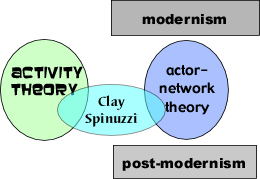
In his book Network - Theorizing Knowledge Work, Clay Spunizzi introduced me to Activity Theory. I was previously familiar with Vygotsky's Zone of Proximal Development and some facets of dialectical materialism, but not their combination in Activity Theory. By contrasting that model with actor-network theory, I gained a far better grasp of ways I can use ANT in my projects.
One of those pursuits is applications of David Ronfeldt's TIMN framework to smaller scales than societal evolution. With that as my frame of reference, I've considered which of the Tribe, Institution, Market or Network phases that Activity Theory applies to. I've tentatively concluded there is a good fit with the Institution phase. That raised a question of how the Activity Theory triangle might get modified to fit a Tribal Activity Theory. I marked up a "Institutional" triangle in red to identify facets that do not fit tribal dynamics. Here's my summary of my modifications to arrive at a Tribal Activity Theory triangle.
When interpersonal communication was entirely oral, it's been widely argued that no one had a concept of being an individual separate from others or their surroundings. The identification with everything in their midst did not support causal, logical reasoning. Happenstance seemed to occur magically which engendered what we now label superstitions, irrationality and paranoia. There was no separate subject to observe, define or work toward an object of attention, desire, intention or pursuit. There would have been no sense of "mediational means" such as tools to use in hand or in mind.
Marshall McLuhan's studies of scholarly analyses of pre-literate cultures suggest there were no jobs to get done until print cultures came along. There was no division of labor or separate responsibilities. There were rituals to reenact that utilized weapons, headdresses, costumes and totems. But these were likely perceived as facets of the community, not as individual items, private property or separate responsibilities. Likewise, there were honor codes and traditions to maintain, but nothing was written down. Conformity was perpetuated with stories, threats of rejection and celebrations of traditions.
Mircea Eliade's research explored other facets of pre-literate cultures. He discovered that progress and the passage of time were regarded as profane, the opposite of sacred. The facets of life that seemed real where repetitious. They honored the ways the orbs in the sky and repeat of changing seasons maintained the myth of eternal return. They would not pursue objectives or deem it necessary to make improvements.
When print cultures emerged, it became possible for institutions to manage large locations, inventories, infrastructures, populations and borders. Technologies were developed to aid construction of buildings, roads, aqueducts and bridges. Tools enhanced the arts of defense, agriculture and governance. Putting "mediational means" at the top of the triangle makes perfect sense once technologies created a stream of dramatic improvements. Putting triangles into chains also fits the emphasis on linear progress "as the new sacred realm". Modeling advances as the result of resolving contradictions fits this technological progress against natural resources, other cultures and past traditions. Prior to those institutions, the tribe itself remained supreme among it's honorees. It was their means to survival and their protection from adversities. The community orchestrated the rituals to remain in the good graces of potentially avenging spirits. The community mediated everything that got done.
All this suggests how Tribal Activity Theory could model those tribal dynamics comprehensively with a simple triangle in spite of our current complexity and sophistication. Nowadays the conformity pressures of a tribal community would seem oppressive to most. We forget how unaware of exploitation the illiterate peasants were prior to Paulo Freire bringing literacy and liberation to their lives. The tribal freedom from production and schedule pressures may seem luxurious to us, but at a high cost in the array of technological advances we take for granted. We almost cannot conceive of getting mediated by an all powerful community of no individuals, separate interests or political strife.
When the community mediates all activities, everyone gets what they need to survive, multiply and reenact traditions. What needs doing gets done without job descriptions, policy requirements or managers. People play the essential parts as needed. What needs doing is routine and easily learned by imitating others who've been doing it repeatedly for as long as anyone can remember. The numbers are small so everyone is on a "first name basis" and accepted within the close knit community. The community mediates all the roles that fulfill the full array of timeless traditions. It's that simple.