Pages

Showing posts with label open minds. Show all posts

7.19.2010

Viewed from the flip side


Over the weekend, I continued to play with the visualization of viewpoints in my last post. I had been thinking there was another viewpoint besides the two in the diagram, imagined to be above the others looking down on them. I then realized there could be another viewpoint at the same level, that did not see ALL the connections, but had a transformational effect on the unwanted reactions to the actions and the outcomes too. This transformational viewpoint sees the whole situation from the flip side of both the persistent and alarmist viewpoints.

A transformational viewpoint cannot see the original problem that was getting solved by the actions. This fits the advice from creativity experts who say "don't become an expert in the problem". Whenever we know too much about the problem, we fall into arguing for limitations, getting intimidated by constraints and losing sight of possibilities. When we know less about the problem, we've set ourselves up to conceive of solutions beyond the immediate quick fix.

A transformational viewpoint is coming from a better place than either of the others. It sees the actions as a partial solution in need of refinement. It sees the unwanted reactions as the specifications of the design challenge. It allows for the situation to present a double-bind at first, like the quip "you cannot live with them and you cannot live without them". In this place, it's natural to ask what-if questions to explore possibilities. It's easy to see the function of forms, the uses made of actions and the effects of what's missing on what's getting done.

From this transformational place, it's possible to realize both/and solutions. Perhaps there are combinations to keep in balance instead of going to one extreme. There may be a synthesis of the "thesis and antithesis" which is much better than either alternative. The action may be done slightly differently in a way that eliminates the reactions and improves the outcomes.

In pondering what prerequisites may constrain getting to this flip side, I came up with the following list:
  • being motivated intrinsically, not being paid contingent upon getting creative enough or getting successful enough at transforming the situation
  • being clear of fear and the dysfunctional thinking we do whenever handling threats, dangers and enemies
  • being inclined to choose how to see things, what incidents mean and which lenses to use to frame complex situations
  • being free to express oneself, be different and seeing things unlike others
  • being sufficiently self confident to unlearn prior certainties, to let go of preconceptions and to trust processes with unpredictable outcomes
  • being future focused enough to put the past where it belongs, forgive the harm done and expect changes will be significant improvements
  • being imaginative enough to play around with possibilities, visualize alternatives and picture the solutions before they're prototyped

Thus, the migration from the persistent or alarmist viewpoint is a daunting challenge. Both non-transformational viewpoints are self-maintaining. Neither embodies the prerequisites or welcomes double-binds. Perhaps the transformational viewpoint has to be introduced by an outsider to the situation and the history of the conflicts.

7.16.2010

Opposing viewpoints


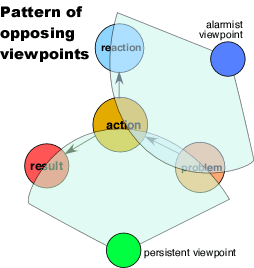
When we adopt opposing viewpoints, we don't see a connection between them. Our field of vision only sees a select number of the connections in the situation. We're threatened by the connections we don't see and any viewpoint that calls them to our attention. In this diagram, I show the typical pattern of opposing viewpoints.

Any typically persistent viewpoint sees a problem. There are obvious connections to actions which address the problem in some way. There are connections to the results of those actions. The results usually confirm the persistent viewpoint. The results look like accomplishments, progress, solutions, benefits, improvements or payoffs.

Any alarmist viewpoint sees the same problem and the connections to the actions taken which address the problem. However this viewpoint sees obvious connections to reactions from taking those actions. These reactions confirm the alarmist viewpoint. The reactions look like unintended consequences, crises in the making, penalties, hidden costs, or long term damage.

The persistent viewpoint does not see the connection between actions and reactions. The alarmist viewpoint does not see the connection between actions and results. Neither viewpoint sees the connections between their opposing viewpoints or the big picture we're seeing by looking down on all this from a higher level.

The opposing viewpoints are hard wired together in a vicious cycle. Each struggles to be right in a way that makes the other wrong. Both have adopted positional stances with their self-confirming evidence. Each is indulging in single-loop learning that goes with what each already knows to do without question. Both are on the same level as the problem where there is no sustainable solution to be found.

We see this problem play out in many ways. There are whistle blowers who see the consequences of corporate greed, corruption and deceit. There are watchdogs to sound the alarm about over-medicating, over-consuming, over-harvesting or over-populating. There are ecologists who foresee the long term consequences of resource depletion, toxic discharges, hazardous dump sites and loss of diversity. There are psychologists who see the impacts of domination, coercion and controls on individual self confidence, self motivation and self expression. The list goes on.

The solutions can be found at the level of the diagram. They occur to the viewpoint that sees ALL the connections . They avoid falling into the trap of opposing any viewpoint which doesn't know what it's missing. It allows for every viewpoint to be partially right and halfway down the path to a sustainable solution.

7.15.2010

Don't say there's a connection

We cannot handle the possibility of a connection when our minds are closed. We experience the connection as a threat to our composure, confidence and comprehension of our situation. We're afraid of getting blamed, wrongly accused or unfairly criticized. We've closed our minds because we're in the midst of enemies, critics or other kinds of hostile parties. We maintain a defensive posture for the sake of our self preservation. When threatened with a possible connection, we're likely to say things such as:
  • I cannot be held responsible for those side effects.
  • How was I supposed to know those were connected all along?
  • It's never been connected and I had no reason to think things had changed.
  • I didn't intend for that to happen when I was acting in good faith.
  • I'm as surprised as you are that those two things are interrelated.
  • You cannot prove there's a consistent connection for me to consider every time.
  • The connection must be some kind of a fluke or rare occurrence.
When we're saying these things, we're thinking there better not be a connection or:
  • I'm in big trouble and will get blamed for this.
  • This will pull the rug out from under my feet and leave me floored.
  • I'll look like a fool and lose credibility.
  • My hot button will get pushed and I'll start acting out of character.
  • My thinking is no longer reliable or capable of making good decisions.
  • Now I'm supposed to understand every hidden connection before I do anything.
  • When people hit me with this, there's no way for me to hit them back.
All this fuss occurs because our minds have been closed for good reason. When we're in the midst of friendly allies, understanding mentors and nurturing supporters, our minds naturally open. We trust we won't get blamed. We're faced with an opportunity to question the connections and learn much more than before about the complex interrelatedness of our situation.

7.14.2010

You say there's a connection

When you say there's a connection between this and that, I'm suddenly full of questions. The mere mention of a connection sets me up in discovery mode. I'm full of wonder, fascination and curiosity. I'm wary of knowing too much already and jumping to foregone conclusions. Here's some of what I usually wonder about when someone says "there's a connection":

  • I wonder if there is a causal relation where a change in this correlates with a change in that, either positively or negatively.
  • I question whether the connection is really acausal, like the classic "chicken & egg" problem where the closed circuit eliminates this coming before that.
  • I suspect that the connection is illusory, supporting an explanation for why this happens when that occurs, but lacking in proof.
  • I explore downplaying the connection, as if it's really insignificant, sporadic or inconsistent in some other way.
  • I investigate the possibility that the connection is much larger than proposed, yielding huge impacts, side effects and long term consequences.
  • I wonder if the connection eludes observation, measurement and verification because it follows a pattern of:
  1. a slow, undetectable buildup until it reaches an obvious critical mass
  2. a flaring up at the slightest provocation and then disappearing when the stimulus gets withdrawn
  3. a delayed reaction as if other components need to be assembled prior to making or using the connection
  4. a pulling back a sling shot, pendulum or spring-loaded mechanism prior to release in the opposite direction
  5. an oscillating between two extremes without stabilizing in the middle
  6. a combining two oscillations which either amplify or dampen the fluctuations
  • I question whether the connection is robust, resilient and sustainable under variable contexts or adversary pressures.
  • I suspect the connection can become disconnected, alleviated or moderated by some intervention, attrition or neglect.
  • I query the origination of the connection and the preliminary conditions that support the formation of the connection.
  • I situate the connection with other connections to discover if the connections compete, provide viable choices or synergize in some way.
  • I seek to enact the connection to get a feel for going there or for taking that route for getting from this to that
In other words, mention of a connection between this and that opens the mind to a phenomenal amount of reflection and collaborative inquiry.

6.28.2010

Are you in a vicious cycle?

It's difficult to discern whether we are in a vicious cycle or not. There's no dashboard we can check to watch for indicators. It's not the sort of query we can Google to get the right answer. There's no app for any held-held that will show you when you're in a vicious cycle or a virtuous one. Here's some ways to watch yourself and observe patterns in your interactions that give clues to this question:
  1. When we're wondering if we are in a vicious cycle, we're definitely not there. Only virtuous cycles run on questions, curiosity, wonder and not-knowing. Vicious cycles depend on already knowing what would happen, having our minds made up and thinking "here we go again".
  2. When we're wondering how to interpret what just occurred and then respond appropriately, we're enjoying a virtuous cycle. When we take the face-value evidence as reason enough to show them a thing or two, we've opted for reacting to others' reactions to our reactions.
  3. When we're dealing with a complex situation by taking several points of view, we're in a virtuous cycle. When we've simplified things to deal with "it" and dismiss the complexity as useless crap, we're going in circles and getting nowhere quickly.
  4. When we're open to changing our minds, learning something new and seeing others' viewpoints more clearly, we're getting energized by a virtuous cycle. When our minds are closed and opposed to getting contradicted, corrected or proven wrong, our energy is getting quickly drained by a vicious cycle.
  5. When we're thinking "it takes two to tango" and we're partly responsible for misunderstandings, conflicts and breakdowns in the relationship, we're maintaining a virtuous cycle. When we convinced the others always deserve all the blame and point a finger at them so there's no mistake who's really wrong, we're doing time in a vicious cycle.
  6. When time by ourselves gives us other perspectives, more questions and deeper fascination with ongoing situations, we're benefiting from a virtuous cycle. We alone-time feels lonely, exposed to negative energy and vulnerable to intense worries, we're trapped by a vicious cycle.
  7. When we have a choice about how to feel, we can choose to feel better, at peace or free of the past -- right now. That may be why those cycles are called "virtuous". When we have no choice, how we feel is hardwired to what happens and we speak of how others "make us feel" as if we're powerless and persecuted in a vicious cycle.

4.06.2010

Where we find the motivation?

Having reflected more deeply on all I've recently learned about our varieties of personal motivation, I'm now seeing a pattern in it all. It seems we find the necessary motivation in different ways depending on the situation. Here's a brief look at that pattern:

  1. When we're living in desperate situations, we call upon our instincts to take the necessary actions. We may be living on the street like the homeless and runaways, in a war zone or failed state or even living in the wilderness. In each case, we will be driven by our survival instincts. We'll feel the urges to do whatever keeps us fed, watered and rested. We also get energized by our herding instinct which seeks safety in numbers when ganging up on others or providing us protection from dangers. Our mating instincts will increase the population for the sake of safety and continuity.
  2. When we're living in stabilized situations, we rely on extrinsic rewards to take the required actions. We may inhabit a cubicle in a big enterprise or work station in a factory. We may own some property and vehicles. We may also keep a full schedule of familiar routines. We do what we're told to do by higher ups, policies or legal systems. We do what we're obligated to do by others relying on us. We comply with requests that pay us to put out the effort. We dismiss those temptations that get penalized severely. We look for ways to cheat and game the system so we get rewarded for less effort or escape the punishment for indulging in a temptation. We make ourselves do what needs has to get done, since our self motivation has been compromised.
  3. When we're living in competitive situations, we rely on our intrinsic motivation to make the extra effort. The chance to excel in comparison to rivals fuels our self motivation to do our best. The set-up to prove to ourselves how good we can become inspires us to take on new challenges. We're motivated to take initiative, stretch ourselves and explore new possibilities. With so much inner drive, we're likely to be overworked and underpaid. Like starving artists, we'll receive much praise and little compensation for our excellence. We'll get taken advantage of for our generosity, willingness to take initiative and sense of responsibility to see things through to completion. We'll make the sacrifice of extrinsic rewards to follow our intrinsic motivations to our heart's content.
  4. When we're living in collaborative situations, we realize the best of every kind of drive in us. We do what we feel like doing because that's how we do our best, get creative about problems and provide the most benefit to others. We receive more than enough extrinsic rewards to prevent them from becoming an issue, distraction or deterrent to self motivation. We find our herding instincts get deeply satisfied by the dynamics of collaboration making compatibility, safety and sustainability a reality. We develop a strong sense of rectitude which preempts any inclinations to cheat, take advantage of others or profit at others' expense.
With this pattern in mind, it seems to me we're equipped with the right kind of drives for every situation we might encounter. When we have motivation problems, we're failing to call upon the appropriate kind of motivation within us. When we're experiencing a flow state, we're finding the right kind of motivation we need for the situation.

4.05.2010

Disdain for questioning authority


Alfie Kohn has written many books about problems in education that tie into the effects of extrinsic motivation in. Like myself, he advocates students thinking for themselves, finding their own motivation and questioning authority. Those of us who encourage each student's independence from authoritative sources will hear complaints from learners like "please don't make me think" or "just teach us what will be on the test". In his essay: Challenging Students... And How to Have More of Them, Kohn relays his own experience:
As a brand-new high school teacher some years ago, I resolved to let my students know that this passivity was not what I was looking for. On my very first day, I proudly — and, given the culture of the school, somewhat defiantly — pinned a yellow button to my shirt that said QUESTION AUTHORITY. Alas, this concept was so unfamiliar to the students that some of them assumed the phrase was a descriptive label rather than an exhortation. One girl wanted to know who had appointed me the school’s question authority.
I'm currently reading a new book: The Art of Choosing by Sheena Iyengar. Her research reveals a wonderful reason for this inability to question authority. She has found that many cultures are founded upon the premise that everything works out for the better when others make choices for us. These cultures arrange marriages for their offspring. They set up the parental figures as authority figures that dictate the conduct of children and less privileged adults. They instill a sense of duty toward and respect of elders. They cultivate dependence on others choices, rather than independence to make one's own choices. Consensus and conformity are far more important than self fulfillment or self expression in these cultures.

Iynegar's research also discovered that a few cultures do not fit this pattern: notably the Brits Aussies and Yankees. We want to make choices for ourselves. We lose motivation, dedication and creativity when others impose their choices on us. We are predisposed to question authority because we are becoming authorities ourselves. We get raised and socialized to become independent, individualized and intrinsically motivated. We assume everything will work out better when everyone is free to explore and express themselves.

I question whether this disdain for questioning authority fits entire cultures. Just as teachers find the consensus/dependence culture in Anglo classrooms, management consultants find it in executive board rooms. It appears prevalent to me in gangs, cults and religious communities. So the applicability of her findings may not be applied as broadly as she proposes, but it has been eye opening for me to realize that large percentages of the global population want others to choose for them.

4.02.2010

Driving on a full tank


Dan Pink's latest book, Drive: The surprising truth about what motivates us, builds on some great ideas from four other books worth reading. Each of these other authors give us advice for driving on a full tank of our own energy. Here's how I'd paraphrase each of these other books' inputs into our thinking about extrinsic and intrinsic motivation.

Flow - The Psychology of Optimal Experience / Mihaly Csikszentmihalyi Whenever we're anxiety ridden about what we're trying to make ourselves accomplish, we going against the flow. We're turning life into a struggle and getting tunnel-visioned out of our frustration with the difficulties. We're already maxed out on the existing challenges and freak out in the face of additional obstacles. We're relying on those "carrots on the table" to get us fired up in order to get through this,. There never seems to be enough carrots.
--- When our body-minds are equally serene and energized, our powers of observation increase. We not only see more, we sense when to respond in ways that turn out to be "spot on". We feel like we're connected with the others involved and any changes unfolding. We welcome more challenges because we're handling them stress-free in this "flow" state of mind. We're feeling blessed by the experience which amounts to receiving an abundance of intrinsic rewards in the moment.

Mindset the New Psychology of Success / Carol Dweck When we think our amount of intelligence is a given learning is something we try to avoid. Anytime we're struggling with comprehension or execution, we think we're exposing our deficient amount of intelligence. It can only be bad to make mistakes and there's no sense in taking risks that could result in blatant blunders. The only way we can get motivated to learn is from the grades and fulfillment of requirements that lead to graduation. The "grade and grad" game is the only game that can be won with fixed amount of intelligence.
--- When we think our intelligence grows as we learn more, learning is inherently rewarding. Struggling to accurately comprehend or execute new understandings will be rewarded with the successful accomplishment. Mistakes are part of the process that help to fine tune approaches and to clear up mistaken assumptions. The greater the risk taken, the greater the reward realized as the result adds to personal confidence, expanded curiosity and deepening satisfaction with the self-motivated exploration.

Why Work Sucks and How to Fix It: No Schedules, No Meetings, No Joke -- the Simple Change That Can Make Your Job Terrific / Cali Ressler & Jody Thompson When we work in a place where we're getting managed, we're obligated to comply with commands, structure and policies. The use of our time is left to other's discretion since we're being paid to show up. We think work is a place we go to, not something we do. We become dependent on the pay and perks to appear dedicated, willing and eager to perform on the job. Meanwhile we're paying a high price in relationships, personal interests and self respect. We may occasionally let our resentment show, but we mostly repress it because "we know what's good for us".
--- When we work in a "results only work environment" (ROWE) how we get a job done is our responsibility. We're given the freedom to work from home, on the road or at odd hours. There's no need to show up for boring meetings since all communications can be handled via cell phones, PDA's and laptops. This approach goes far beyond flex time or employee empowerment. It restores the ability of individuals to do their best work when respected, trusted and admired for getting it done as they see fit. Self motivation soars with resulting increases in coordination, cooperation, communication and commitment.

Predictably Irrational: The Hidden Forces That Shape Our Decisions / Dan Ariely When we're operating under market norms, we're available for a price. We wonder what others will cost us to cooperate with our intentions. We assume they can be bought like ourselves. We will seek a fair price while becoming vulnerable to irrational comparisons. We'll have no concept of cheapening the relationship or reducing others' genuine initiative to our successful manipulation of their incentives.
--- When we're operating under social norms, we do things out of the goodness of our heart, consideration for others and our genuine commitment to the common good. We express our self respect through what we do for others in respect for their needs, outlooks and limitations. We take offense when someone introduces market norms while we're happily self motivated, generous and satisfied.

3.26.2010

From losing out to dropping out

A large number of newly hatched educators drop out of the teaching profession every year. An even larger number of high school and college students drop out before graduation. This morning I've been exploring the possibility of a gradual process building up enough frustrations to culminate in dropping out regardless of age or maturity. The process starts with losing out, followed by acting out which leads to burning out which ends up with dropping out. This process applies equally to teachers and students. The consequences of closed minds, extrinsic rewards and linear delivery systems play no favorites.
  • Losing out: When receiving formal evaluations of performance that determine the amount of reward, intrinsic motivations go into hiding. It does not matter whether the rewards impacted by the evaluation are points on a quiz or the size of a pay raise. The person framed by contingent rewards no longer gets in the mood to do anything and can only force themselves to show up. They stop getting creative ideas, empathic insights into others or inspired alternatives to solve chronic problems. They lose out big time.
  • Acting out: After the loss occurs, a bounty of negative emotions arise. There's anxiety about the loss and suspicions of personal inadequacies. There's lots of resentment toward the authority figures to dish out those supposedly objective evaluations. There's frustrations with how much of the required activities seem contrived, useless and senseless. Finally, the inner turmoil gets acted out as misdirected anger, retaliatory hostilities or other forms of taking one's own frustrations out on others.
  • Burning out: The cathartic experiences of acting out only provide temporary relief. There is a concurrent loss of stamina, endurance and motivation. those who've passed through phases of losing out and acting out become more passive, dependent on others and incapable of personal initiative. Feeling numb, bored and indifferent leads to acting bored, apathetic and indifferent. Commitments seem annoying. Requests seem like impositions. Conversations seem excessive. Burnout has replaced acting out.
  • Dropping out: The situation calls for a "fight or flight" response. The pervasiveness of the adversity seems far too extensive to fight it. Nearly everyone appears to be content with feeding the problem, perpetuating the abuses and ignoring the effects on individuals. It's taken for granted that participants would lose out, act out and burn out. Everyone is looking at what's going on with closed minds. The only solution is to get out of the toxic system. It seems like the open-minded thing to do that may possibly revive intrinsic motivations and self respect.
The dropouts' assessment of the problem appears accurate to me. There's no solution at the level of changing job/course requirements, pay/grades rewards or counseling/advising interventions. The system needs to replace uniform requirements with self-selected explorations, extrinsic with intrinsic rewards and content delivery with peer reciprocation systems that will open closed minds.

3.25.2010

Emotions vs. feelings

One of the many reasons we keep our minds closed is to keep a lid on our emotional turmoil. We've had bad experiences of our uncontrollable outbursts which teach us to suppress those urges diligently. These experiences give our irrational side a bad name. We assume anything that is not logical has to be problematic and in need of control. We pride ourselves in being rational at great expense to our intrinsic motivation, empathy for others and personal creativity. We assume self discipline and self control are viable solutions. We don't realize we've gotten out of touch with our feelings just like zombies, ice queens and robots make so obvious to us.

Feelings are very different experiences from our emotions. Emotions are irrational in ways are are incompatible with rationality. Feelings make tons of sense and add a deeper dimension to our logical reasoning. Emotions arise from our primitive limbic system in ways that hijack our thinking mind. Feelings come more from our right brain where we receive inspirations, inner guidance and panoramic awareness of situations. Emotions are a problem that accompanies closed minds. Feelings are solutions which come to open minds. Feelings give our irrational side a good name.

We're in touch with our feelings whenever we:
  • bask the beauty, blessings and good fortune of the scene out the window or before us outdoors
  • get a sense of the best time to do something to have the best effect
  • experience a harmless connection to particular animals or plant life
  • happen to be "in the right place at the right time"
  • lose track of time when we're immersed in some activity we enjoy deeply
  • get more curious, fascinated and full of wonder about something we're exploring
  • exude compassion toward those in need of comfort, support or understanding

As you may discern from that list, feelings differ from emotions in many dimensions. In contrast, positive and negative emotions are:
  • urgent and driven
  • expressions of appetites and hungers
  • seeking to control or intimidate others
  • reacting to evidence with fear and desperation
  • fixated on literal interpretations of evidence
  • manipulating the impressions others have of us
  • insensitive and inconsiderate of others
Hope you now have a feeling for the difference between emotions and feelings :-)

3.24.2010

Actions speak louder than words

Closed minds act as if "words speak louder than actions". Closed minds ignore how they appear to be acting. They expect people to "do as I say, not do as I do" and never mind the mixed signals.

Open minds take the opposite approach. They presume that "actions speak louder than words". What's even better is the congruence of words and actions, a.k.a "walking the talk". When people can follow both our words and/or our actions and get the same message, we earn some serious credibility.

That raises the question of what am I doing right now and what that allows you to do? If you've been habituated into being told what to think at great expense to thinking for yourself, you may assume my actions are telling you you'd better not be thinking differently from me. However I have very different ideas about how I'm acting while I'm writing these words. Here's some possibilities:
  • I'm expressing myself in this blogging venue that gives you equal freedom to express yourself.
  • I'm reflecting on my recent experiences and sharing insights gleaned from them -- in hopes that you would do the same with your experiences.
  • I'm creating insights into facets of experiences we may have in common that could give you fresh ways to see what you're facing.
  • I'm exploring concepts that fascinate me as an example for you to explore concepts that fascinate you.
  • I'm finding the flow to go with prior to writing anything so you also get the feeling of well-timed actions coming to you easily.
  • I'm generating digital content for a searchable archive that may serve so anytime in the future that your own keyword search comes across this.
  • I'm showing you how to follow my example of using words to get others to reflect more deeply on their own experiences.
Just because I presume to be acting in these ways, does not mean these actions would speak to you as they do to me. When actions speak louder than words, they cannot be taken literally. They provide gestures to interpret with one's own frames of reference as well as mine if you can empathize with me. Looking through my frames of reference calls for an open mind, just like embracing the possibility that actions speak louder than words.

3.23.2010

Watching for intrinsic motivation

Over the weekend, I searched YouTube for videos on intrinsic motivation. I found a couple TED talks by authors on the subject and some animations from the long tail of crowdsourced content generators. Neither paid author appeared to be intrinsically motivated in their body language, tone of voice or presentation format or use of graphics. The animations seemed intrinsically motivated to me. This contrast appeared to fit the pattern I wrote about in Quality of writing for hire where the unpaid writers create text that is far more readable and rewarding. That page was the third most read of mine last year - further indication of the impact of intrinsically motivated explaining, writing and presenting.

My further reflection on this weekend discovery led me to another question: What is there to look for when watching for intrinsically motivated authors, experts and consultants? Here's what I came up with to answer that question of mine:

  • Really want to do it or making themselves do it - When we're intrinsically motivated, getting paid is an added bonus, but not the reason or incentive to contribute. We're glad to be doing it because it feels fulfilling and purposeful. We have a sense that we're the right person for the job that comes at an especially good time for us.
  • Relating to the audience or taking a defensive posture - When we're intrinsically motivated, we're expressing our concerns for others, making offers of solutions, and sharing insights that may relieve some others' anxieties. We've anticipated how to prevent their confusion and address their viewpoint.
  • Welcoming interpretations or insisting on one right answer - When we're intrinsically motivated, we realize how everyone's motivation, perceptions and attributions are unique. We expect the value in our self expression will be taken many different ways through many varied filters by others.
  • Offering a work in progress or the final answer - When we're intrinsically motivated, we're filled with wonder and fascination. We don't know what our activities will bring to us to give to others. We're caught up in an immersive exploration that only allows for us to offer timely progress reports.
  • In the flow or struggling under pressure - When we're intrinsically motivated, we're thinking "yes, thanks, more please" to life right now. We're basking in the bounty of good things coming our way. We relate to adversity as welcome challenges that will likely bring out our best character, inner resources and creativity.
Each of these distinctions are easily detected in writing, videos and presentations. We can tell which side of the line others fall on. We may also use these as standards to hold ourselves to our criteria to evaluate our own contributions.

3.22.2010

Open minds and self respect

Here's a pattern that became evident to me amidst the drama of last week:

When our minds are closed, we're inclined to respect authority without question. We seek the approval of those whom we believe are superior to us in ability, power and experience. We sense that we cannot respect ourselves because we're lacking in those superior qualities. We remain needy, insecure and vulnerable to exploitation while our minds are closed.

Authority figures with equally closed minds help us to keep our minds from opening up. They reward us with extrinsic prizes that trash our intrinsic motivations. They dish out enough disrespect to keep us insecure and needy for their approval. They punish those with self respect for failing to respect the authority figure's superiority from their own place of inferiority. They have problems with those who's self respect guides them to do the right thing, rather than conform, comply and submit to power-hungry coercion.

When our minds are open, we're inclined to question authority. We seek answers and guidance within for wise outlooks, choices and priorities. We find a self within that is worthy of respect regardless of what others' opinions may insist upon. We're accepting of our self respect evoking disrespect from others. We can perceive those who dish out disrespect as lacking self respect or any sense to do the right thing. They cannot respect themselves because their minds are closed, they are addicted to extrinsic rewards and they have not found a self within to respect.

With our self respect, we naturally respect others with self respect. We don't need their respect, but it comes without trying. We fulfill the paradox of "those that get the most respect do not need it because they already have self respect". With that self respect comes the curiosity to explore where our intrinsic motivations lead us. We learn more informally and set up others to do the same.

3.19.2010

Harnessing renewable motivation sources

In Drive: The surprising truth about what motivates us - Dan Pink compares the use of performance-contingent rewards to burning coal and the nurturing of intrinsic motivation to solar power. He focused on how coal is a cheap fuel to burn with costly consequences. As I reflected on his analogy, I recalled that infamous picture of steel mills in full production putting out so much smog the streetlights were left on in the daytime. That image perfectly fits the toxic impact of extrinsic rewards on intrinsic motivation. To add the image of solar power to this, the smog of coal-fired, non-renewable, extrinsic rewards blocks the renewable sunshine from getting used as an energy source.

This analogy rings true to my experience with my own intrinsic motivation. It's not even slightly difficult for me to get fired up to do the things I love to do, including reading and writing for this blog. Yet whenever I get dragged down by something I have to do, in spite of it's bad timing, ill conceived solution or wasted effort, I have lots of trouble getting back in touch with my intrinsic motivation. It's as if I have polluted my mental skies anytime I avoid a stick or earn a carrot. Consequently, I cannot see through the smog of performance-contingent motivation I've poured out my smokestack to that boundless source of renewable energy in me.

When I've addressed this contrast between extrinsic and intrinsic motivation with executives or college students, I've used a different metaphor. I compare intrinsic motivation to the lifeblood of any vibrant endeavor. Full blooded efforts are energizing, as if there is a renewable source of motivation within us. When we're tapped into our intrinsic motivation, we lose track of time and amaze ourselves with our endurance, dedication and zest. We get into "the zone", also called the "flow state".

I've defined the blood chemistry of lifeblood with DS/RAM components: Dignity, Self Reliance, Autonomy and Meaning:
  • Dignity: We respect our abilities, limits, passions and perspectives. With self respect and trust, we have the basis to respect and trust others.
  • Self Reliance: We trust ourselves to keep our commitments, deliver results and learn to do things better. This may require asking for help, getting shown a better way or admitting our lack of experience.
  • Autonomy: We realize we perform better when we're left to decide how to do it and when to get it done. We find we're a better judge of what we had in mind and what problems we created for ourselves.
  • Meaning: We put our own spin on everything and see what we want to see. When this subjective process works for us, we see cups as half full, see clever ways to turn lemons into lemonade and see solutions within the obvious problems.
Conventional management and personnel evaluation methods throw this baby out with the bath water. It reminds me of the archaic practice of bloodletting whenever the life blood of an endeavor has been removed by higher ups and control tactics. Manipulators of extrinsic rewards try to solve motivation problems by removing DS/RAM. By draining the participants of their "bad blood", it's assumed they will be more motivated. Bloodletting killed George Washington, the first President of the US, after he had retired to Mount Vernon. The practice of getting bad blood to cure sickness was still being used during the Civil War in the next century.

It appears we are equally slow to catch on to harness intrinsic motivations and renewable energy sources. As Dan Pink says, our management practices are twenty years behind the science. He wonders whether we may end up eliminating the profession of management once we realize how self motivated everyone can be when they're not getting managed. I'm thinking we will even be competent at evaluating ourselves once work gets done informally.

3.18.2010

Get the carrots off the table!

When we're faced with the challenge of getting others to do the work, take the necessary initiative and/or produce the desired results, we can approach this with an open or closed mind. In either case, the outcome depends on the others' motivation. They may be self-motivated or "in need of some motivation". The work may be "no-brainer" or calling for lots of resourcefulness, problem solving and responsiveness to situational variations. As Dan Pink shows us in Drive: The surprising truth about what motivates us - the situation may be safe for using extrinsic rewards or fraught with peril.

If we are in danger, our minds will be closed by default. We may be in danger of failing to get the others to do the work. We may be apprehensive about trouble coming from higher ups, clientele or team members who are relying on us to get this done. We may be in danger of the others only making a show of trying to do the work, coming up with excuses or getting distracted by other responsibilities. We may also face dangers of doing more harm than good, creating a worse problem and trashing future cooperation by bungling our use of rewards.

If our minds are closed, we will delude ourselves into thinking it's wise to put carrots on the table. We will set goals and reward the others if they meet the imposed targets on time and under budget. We may create a contest where the best completions win a prize while the others lose out on getting rewarded. We may established a metric to monitor progress and outcomes objectively so the others can compete and beat out their rivals. We might even give everyone a reward if they complete the sequence, but give bigger rewards for the bigger results.

Everyone of these schemes offers extrinsic motivation contingent on performance. These rewards implicitly enforce compliance, control contributions and restrict variations in conduct. They put people "on a short leash" and "pull their chain". Their potential self motivation gets overridden by chasing after the carrots on the table. The lose track of their intrinsic purpose, satisfactions and abilities to grow from the experience. They feel like "slaves to the machine" doing "no brainer work" even if the work is really complex and challenging.

When our minds are open, we get those insidious carrots off the table immediately. We eliminate the potential harm induced by contingent rewards. We make sure everyone has enough resources to run with the ball and solve the problems they encounter. We verify that everyone is getting equal opportunities and fair treatment. We realize their intrinsic motivations will thrive when each is given discretion over what they do, how they do it with whom, when they do it and why they are getting the work done. We assume people have the drive to get things done better than before so long as we stop sabotaging their intrinsic motivation.

3.17.2010

Addicted to extrinsic rewards


I'm currently reading and enjoying Dan Pink's latest book: Drive: The surprising truth about what motivates us. Light bulbs have been going off in my head as he reveals empirically verified patterns of human motivation. I've known myself to be intrinsically motivated as far back as elementary school. But I've not felt I really understood those who go after the highest grades, who rack up the most points on the scoreboard or who compete with colleagues for the biggest paycheck. They appear to make the reward an end in itself, rather than incidental to the deeper pleasures of the process, journey and self-realizations. This book tells us that those who devote themselves consistently to contingent, extrinsic rewards are addicted to them. They lack intrinsic motivation due to the insidious effects of extrinsic rewards on one's sense of self determination and autonomy.

All this correlates with what I've been exploring recently about closed minds. An open mind explores the potential significance, value and personal responsibility in a task where it realizes some self motivation to get it done. A closed mind exploits the potential conquest, advantage and power to control others in a task. The closed mind then depends on the reward to make the task worthwhile and it eventually loses motivation once the thrill is gone. The people I get along with easily are all self motivated and appreciative of their own intrinsic rewards. Those people I know who have become addicted to extrinsic rewards show all these telltale signs of trashing their intrinsic motivation and open minds:
  • Keeping their eyes on the prize and love for the scoreboard while losing sight of the purpose, significance and value of the pursuit.
  • Seeming disoriented and desperate when encountering someone with autonomy from approval-seeking, self-respecting healthy boundaries and robust intrinsic motivations
  • Framing every situation to their personal advantage with lenses of superior/inferior, advantaged/disadvantaged, winners/losers, or in control/out of control
  • Stockpiling materialistic evidence of their extrinsic worth to compensate for feeling inadequate, empty, insatiable and desperate
  • Acting driven to control others, tell them how to live and blame them for any sources of embarrassment, bad publicity or censure
  • Expressing their devotion to private wealth with no concept of commonwealth, common good and common interests with those "lowly common folk"
  • Experiencing defeat, loss and victimization when forced to pay taxes or their fair share in collective efforts
To consider these behavior patterns as symptoms of an addiction has been eye-opening for me. Conduct like this may reveal insatiable appetites, poor judgment, desperate pursuits and denial of the pattern itself. They suggest a haunting empty feeling that no extrinsic rewards or pleasures can really fill. They also predict the addicts' urges to manipulate other's suspicions with deceits, false pretenses and inflated promises. They are trapped in a perpetual cycle of "people pleasing" that fails to diminish the barrage of disrespect, defiance and self contempt. Their recovery calls for opening their minds to their own intrinsic motivations.

3.16.2010

More than open minded

When we get entangled with closed minded people, we lose sight of what all is possible for us to experience with others. We get captivated with a bunch of predictable problems that come with the territory of pervasive closed mindedness. We're likely to be on the receiving end of a boatload of disrespect because closed minded individuals cannot respect themselves or others. Likewise, we're not going to be trusted by those who cannot trust themselves or others. We will be showing up in their play space, looking like a thing to be toyed with, manipulated, controlled or kicked around. We're apt to get deceived by their coverups and attempts to avoid scrutiny. Finally, we will look like a loss, unfair expense or other kind of burden in their selfish world where everyone can only look out for themselves. All this adds up to one big nightmare which obscures all that is possible for us to experience with others.

When problems like these seem inevitable, so are their complete opposites. We'd be wise when entangled to flip out into what we can alternatively experience with others who are also "more than open minded". Here's how I imagine that possibility unfolding:
We're basking in mutual respect as each one of us respects ourselves deeply and treats others to that same respect. Likewise, we trust ourselves to deliver on our promises, find solutions to problems and value others in ways that put us on very solid ground. We find we have the basis to trust others embodying a trust of themselves and stand our ground when that trust gets violated.

We're enjoying receiving the attentions of open minds that approach us with curiosity. We see that we are showing up to others as possibilities to explore, mysteries to delve into and stories to follow along. Likewise, we are wondering about the significance of encounters, fascinated by the nuances in what's occurring and thrilled by the common ground that's emerging among us.

We eager to reveal our unresolved issues and complex decisions still in progress. We seek input into our lingering questions in need of reformulation and disturbing observations that could benefit from other viewpoints. We encounter the same transparency and happily recognize ways to lend a hand, offer support and share experiences with others. We find we are "talking with" instead of "talking at" and learning as much by giving as by receiving insights.

We're immersed in intrinsic rewards, motivations and significance. We run deep when asked "why we're here?", "what we're up to?" or "how we're experiencing this occasion?". We're noticing how these unfolding incidents seem perfectly timed, revelatory or responsive to previous requests. We're enchanted by encountering the same richness and depth in the others. We're finding there is so much to explore beyond "who said what to whom" when these realms of subtle meaning enter into the conversation.

When we're entangled in none of the above, we can't even imagine such possibilities. We can detail others about the particular adversities delivered by other closed minds, but not consider how good it can get when interacting with others who are more than open minded. It takes calling a time out to get into the imaginative space of possibilities like I've envisioned here.

3.15.2010

Killing the viral launch


This morning I was asked what I had learned from my reading of Viral Loop: from Facebook to Twitter, how today’ smartest businesses grow themselves by Adam L Penenberg. My first takeaway was how much work is involved in launching any new online venture that scales exponentially. The challenges posed to the IT crew are staggering. Projects that build infrastructure for three years prior to launch (like ning) are designed to scale far better than those that cobble some servers together at first and cope with scaling after it occurs. This posed a stark contrast in my mind between formal systems on dedicated platforms with user login protocols and informal systems that require no login and are free to be distributed over any and all social networking platforms.

My bigger takeaway dealt with four ways to kill a viral launch before it begins to takeoff. Each of these are approaches that closed minds would formulate confidently:
  • Develop a delivery system for a product/service mix designed for end users. The interaction is completely over when the customers make use of it. There's nothing to share with others or invite others to join. Consuming products and services is the main activity.
  • Keep the development process opaque to the public. Conduct design sessions, in house dialogues and internal debates in private. Avoid any process transparency that could inadvertently develop trust in the offering, identification with the team members or faith in their noble intentions. Keep people from talking about the evolving story in the quixotic product development process or the struggles in getting to launch.
  • Offer complete answers, solutions and systems to the unreliable public. Leave nothing to chance, misinterpretation or tampering. Forestall any conversations that might question the value, interpret the offer creatively, challenge the propaganda insightfully or explore other innovative uses.
  • Overcharge for the offering -- using the freebie as mere bait, deception and temptation. Eliminate any continual free use by forcing everyone to pay after an initial trial period. Preclude any large following where a small percentage value the premium version and subsequently pay for all the others.

To think this way, all we have do is close our minds. The details will take care of themselves. There no need to consider how to be controlling, how to dehumanize others or how to send the wrong message to eager early adopters. Keeping focused on the launch of the perfect product after a long production effort will do everything required to kill the viral launch.

3.12.2010

How do minds open?

Every kind of perceived danger can close our minds without consciously thinking about it. We make up our minds in a hurry to dismiss, disregard and disrespect those who appear dangerous. Our minds close as a safety precaution in order to be ready for fast "fight or flight" reactions. Times of danger are no time for exploring possibilities, reflecting of different meanings or delving deeper into the alarming situation to come up with a different diagnose.

This raises the question "how do minds open?". It can be argued that we live in constant danger where there is never a good time to open our minds. That may be true in abuse relationships, war zones and processes of elimination. But there are many occasions where it appears safe and seems wise to open our minds for the time being. We typically open our minds whenever:
  • it seems like someone has "got our back" and is looking out for our interests as if we're on common ground
  • it's evident that some gets our point of view, sees things through our eyes and shares some of our interpretations
  • it feels like someone is saying "peek a boo I see you" to us by accurately reading our intentions, frustrations and connections
  • it's a relief that someone has "de-escalated the adversarial tensions" by acknowledging conflicting interests, concerns and considerations
  • it's apparent that someone is reaching out to better understand us, explore more of where we're coming from and what we have in mind
  • it's heartwarming that someone is approaching us with respect, fascination and compassion
  • it's informative that someone understands a beneficial facet about our own conduct and effect on others better than we do ourselves
Each of these experiences suggest it's time to feel safe. We can let our guard down and open our minds. Times have changed for the moment from needing to act defensive, cautious and vigilant. We can let in what's happening as if some good will come of it that we're not controlling or making happen ourselves. We feel like we're getting served well, cared for insightfully and protected from immediate dangers.

3.11.2010

Working with or against others

When our minds are closed, we cannot work with others for their good or for the greater good. It makes perfect sense to work against others and for our own interests as if the two are in opposition. Win/win deals appear to be a losing proposition to closed minds that are wary of giving advantages to the known enemy. Working with others seems naive and vulnerable to being exploited before getting a chance to exploit the others.

When our minds are closed, we need to make enemies of others. We cannot live with ourselves or accept every facet of our total being. We are at war with ourselves and eager to stop taking our frustrations out on ourselves. We project our intolerance onto others whom we find unacceptable, at fault or deficient without a doubt. We make them into our scapegoat, "whipping boy" or "messenger that needs to be shot down". We ease our chronic anxiety, stoked by our self contempt, with attacks on others' composure and confidence.

Working with others is different from collusion and conspiracy intended to really work against others. Working with others begins by getting others understood. That new understanding then breeds compassion, empathy and deeper insights into others. We get an inspired sense of how to work with others and what difference to help them make in their lives. We contribute to a strong system that transitions any weakness into a strength, resource, skill set or effective strategy.

Our open minds are really relating to others who feel moved to do the same for us in return. The inter-relation with others becomes a both/and proposition of benefiting from giving and receiving or from understanding others and getting understood by others. We care for ourselves by caring for others. We gain more than we expected by giving up looking after our own interests. Self interest, amidst working with others, becomes a paradox of selfishly being selfless.