Pages

7.19.2010

Viewed from the flip side


Over the weekend, I continued to play with the visualization of viewpoints in my last post. I had been thinking there was another viewpoint besides the two in the diagram, imagined to be above the others looking down on them. I then realized there could be another viewpoint at the same level, that did not see ALL the connections, but had a transformational effect on the unwanted reactions to the actions and the outcomes too. This transformational viewpoint sees the whole situation from the flip side of both the persistent and alarmist viewpoints.

A transformational viewpoint cannot see the original problem that was getting solved by the actions. This fits the advice from creativity experts who say "don't become an expert in the problem". Whenever we know too much about the problem, we fall into arguing for limitations, getting intimidated by constraints and losing sight of possibilities. When we know less about the problem, we've set ourselves up to conceive of solutions beyond the immediate quick fix.

A transformational viewpoint is coming from a better place than either of the others. It sees the actions as a partial solution in need of refinement. It sees the unwanted reactions as the specifications of the design challenge. It allows for the situation to present a double-bind at first, like the quip "you cannot live with them and you cannot live without them". In this place, it's natural to ask what-if questions to explore possibilities. It's easy to see the function of forms, the uses made of actions and the effects of what's missing on what's getting done.

From this transformational place, it's possible to realize both/and solutions. Perhaps there are combinations to keep in balance instead of going to one extreme. There may be a synthesis of the "thesis and antithesis" which is much better than either alternative. The action may be done slightly differently in a way that eliminates the reactions and improves the outcomes.

In pondering what prerequisites may constrain getting to this flip side, I came up with the following list:
  • being motivated intrinsically, not being paid contingent upon getting creative enough or getting successful enough at transforming the situation
  • being clear of fear and the dysfunctional thinking we do whenever handling threats, dangers and enemies
  • being inclined to choose how to see things, what incidents mean and which lenses to use to frame complex situations
  • being free to express oneself, be different and seeing things unlike others
  • being sufficiently self confident to unlearn prior certainties, to let go of preconceptions and to trust processes with unpredictable outcomes
  • being future focused enough to put the past where it belongs, forgive the harm done and expect changes will be significant improvements
  • being imaginative enough to play around with possibilities, visualize alternatives and picture the solutions before they're prototyped

Thus, the migration from the persistent or alarmist viewpoint is a daunting challenge. Both non-transformational viewpoints are self-maintaining. Neither embodies the prerequisites or welcomes double-binds. Perhaps the transformational viewpoint has to be introduced by an outsider to the situation and the history of the conflicts.

7.16.2010

Opposing viewpoints


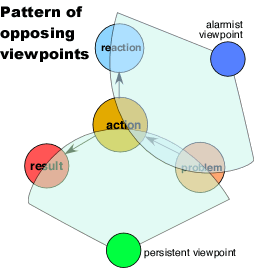
When we adopt opposing viewpoints, we don't see a connection between them. Our field of vision only sees a select number of the connections in the situation. We're threatened by the connections we don't see and any viewpoint that calls them to our attention. In this diagram, I show the typical pattern of opposing viewpoints.

Any typically persistent viewpoint sees a problem. There are obvious connections to actions which address the problem in some way. There are connections to the results of those actions. The results usually confirm the persistent viewpoint. The results look like accomplishments, progress, solutions, benefits, improvements or payoffs.

Any alarmist viewpoint sees the same problem and the connections to the actions taken which address the problem. However this viewpoint sees obvious connections to reactions from taking those actions. These reactions confirm the alarmist viewpoint. The reactions look like unintended consequences, crises in the making, penalties, hidden costs, or long term damage.

The persistent viewpoint does not see the connection between actions and reactions. The alarmist viewpoint does not see the connection between actions and results. Neither viewpoint sees the connections between their opposing viewpoints or the big picture we're seeing by looking down on all this from a higher level.

The opposing viewpoints are hard wired together in a vicious cycle. Each struggles to be right in a way that makes the other wrong. Both have adopted positional stances with their self-confirming evidence. Each is indulging in single-loop learning that goes with what each already knows to do without question. Both are on the same level as the problem where there is no sustainable solution to be found.

We see this problem play out in many ways. There are whistle blowers who see the consequences of corporate greed, corruption and deceit. There are watchdogs to sound the alarm about over-medicating, over-consuming, over-harvesting or over-populating. There are ecologists who foresee the long term consequences of resource depletion, toxic discharges, hazardous dump sites and loss of diversity. There are psychologists who see the impacts of domination, coercion and controls on individual self confidence, self motivation and self expression. The list goes on.

The solutions can be found at the level of the diagram. They occur to the viewpoint that sees ALL the connections . They avoid falling into the trap of opposing any viewpoint which doesn't know what it's missing. It allows for every viewpoint to be partially right and halfway down the path to a sustainable solution.

7.15.2010

Don't say there's a connection

We cannot handle the possibility of a connection when our minds are closed. We experience the connection as a threat to our composure, confidence and comprehension of our situation. We're afraid of getting blamed, wrongly accused or unfairly criticized. We've closed our minds because we're in the midst of enemies, critics or other kinds of hostile parties. We maintain a defensive posture for the sake of our self preservation. When threatened with a possible connection, we're likely to say things such as:
  • I cannot be held responsible for those side effects.
  • How was I supposed to know those were connected all along?
  • It's never been connected and I had no reason to think things had changed.
  • I didn't intend for that to happen when I was acting in good faith.
  • I'm as surprised as you are that those two things are interrelated.
  • You cannot prove there's a consistent connection for me to consider every time.
  • The connection must be some kind of a fluke or rare occurrence.
When we're saying these things, we're thinking there better not be a connection or:
  • I'm in big trouble and will get blamed for this.
  • This will pull the rug out from under my feet and leave me floored.
  • I'll look like a fool and lose credibility.
  • My hot button will get pushed and I'll start acting out of character.
  • My thinking is no longer reliable or capable of making good decisions.
  • Now I'm supposed to understand every hidden connection before I do anything.
  • When people hit me with this, there's no way for me to hit them back.
All this fuss occurs because our minds have been closed for good reason. When we're in the midst of friendly allies, understanding mentors and nurturing supporters, our minds naturally open. We trust we won't get blamed. We're faced with an opportunity to question the connections and learn much more than before about the complex interrelatedness of our situation.

7.14.2010

You say there's a connection

When you say there's a connection between this and that, I'm suddenly full of questions. The mere mention of a connection sets me up in discovery mode. I'm full of wonder, fascination and curiosity. I'm wary of knowing too much already and jumping to foregone conclusions. Here's some of what I usually wonder about when someone says "there's a connection":

  • I wonder if there is a causal relation where a change in this correlates with a change in that, either positively or negatively.
  • I question whether the connection is really acausal, like the classic "chicken & egg" problem where the closed circuit eliminates this coming before that.
  • I suspect that the connection is illusory, supporting an explanation for why this happens when that occurs, but lacking in proof.
  • I explore downplaying the connection, as if it's really insignificant, sporadic or inconsistent in some other way.
  • I investigate the possibility that the connection is much larger than proposed, yielding huge impacts, side effects and long term consequences.
  • I wonder if the connection eludes observation, measurement and verification because it follows a pattern of:
  1. a slow, undetectable buildup until it reaches an obvious critical mass
  2. a flaring up at the slightest provocation and then disappearing when the stimulus gets withdrawn
  3. a delayed reaction as if other components need to be assembled prior to making or using the connection
  4. a pulling back a sling shot, pendulum or spring-loaded mechanism prior to release in the opposite direction
  5. an oscillating between two extremes without stabilizing in the middle
  6. a combining two oscillations which either amplify or dampen the fluctuations
  • I question whether the connection is robust, resilient and sustainable under variable contexts or adversary pressures.
  • I suspect the connection can become disconnected, alleviated or moderated by some intervention, attrition or neglect.
  • I query the origination of the connection and the preliminary conditions that support the formation of the connection.
  • I situate the connection with other connections to discover if the connections compete, provide viable choices or synergize in some way.
  • I seek to enact the connection to get a feel for going there or for taking that route for getting from this to that
In other words, mention of a connection between this and that opens the mind to a phenomenal amount of reflection and collaborative inquiry.

7.13.2010

In the works for future posts

As you may have recently noticed, blog posts are coming at less than my usual one-per-day pace. I'm in the midst of several big landscaping projects at the house are consuming tons of my physical and mental energy. So that you don't think I've fallen off the map, here's what I expect will appear here soon:

I'm currently reading Richard Florida's latest book: The Great Reset - How New ways of Living and Working Drive Post-crash Prosperity. The book emerged from an article he created for Atlantic Monthly which generated lots of buzz. I'm thrilled with the first 8 chapters. His perspective on the creativity that flourishes during economic depressions will sharpen by forecasts about the next economy.

I've started to read Dan Ariely's new book: The Upside of Irrationality - The Unexpected Benefits of Defying Logic at Work and at Home. This will tie in beautifully with my ongoing explorations of cognitive neuroscience that appear under the tag: use your brain. Concurrent with that, I'll also be reading John Ehrenfeld's Sustainability by Design - A Subversive Strategy for Transforming our Consumer Culture. That book looks like a gem for implementing a wide variety of large scale disruptive innovations, like I've considered for higher ed.

My recent posts exploring business models have me thinking again about David Ronfeldt's TIMN model. I've playing with a new premise that is not yet formed into more than a few words. I suspect we draw the line between Institution and Market epochs in the wrong place. That then makes it nearly impossible to foresee what the Network epoch will change, provide and replace. This may help me return to the argument I was developing in my post Changing forms of mediation. I got stuck when I tried to delineate the Network version of mediation. By redefining Institution and Market, the problems with defining Network may disappear.

Stay tuned!

7.12.2010

Where's the mission of an enterprise?


In the many times I've taught Strategic Management to college seniors, I've made a big issue out of the mission of an enterprise. So often, a business will get so caught up in crises it will lose sight of its mission. It loses its sense of purpose, direction and meaning. The dedicated employees feel adrift in a sea of anxiety, pressures and obligations. They characterize themselves as slaves or whores, not as talented individuals worthy of respect. The loss of mission infects their self confidence, intrinsic motivations and eagerness to contribute to the overall effort.

When the mission statement feels lost, top management typically issues a "blanket statement" of platitudes that does nothing to alleviate the fallout. It functions as a wet blanket that puts out the last embers of passion, purpose and participation among the employees. By trying to offend no one, it offends everyone.

This morning I've been visualizing where we find the mission in spatial frameworks. I've concluded the location depends on the business model, strategy and structure in use. Within hierarchal institutions with excessive top-down authority, the mission hangs over everyone at the top. In flat, equally bottom-up/top-down, democratically-run enterprises, the mission provides the solid ground for everyone to stand on. Here's how those two positions for mission statements play out.

It makes sense to top executives in large hierarchies that mission statements belong above everything else. Like their structure with an all-knowing big-brain at the top of the organizational pyramid, the mission dictates from above the strategy to fulfill the mission. That strategy, in turn, defines the lowly tactics to implement the strategy. The mission plays an authoritative role, just like top management. Both presume that the big picture is inaccessible to those in the trenches and needs to be dictated by higher ups to the lower echelons. When employees see the mission, they are looking up to higher levels of consideration, outlook and comprehension.

On the contrary, it makes sense to servant leaders and mentors in flat organizations that the mission is the lowest common denominator. Like the structure that balances bottom-up with top-down flows of authority, the mission arises from those closest to the work, customers, delays, overruns and setbacks. It reminds everyone "why we're here", "what difference we're making", and "what our success depends upon". It puts all those varied efforts on solid ground. Individuals look down to the footing, basis and support for their efforts. The mission gives purpose, context and meaning to the daily grind, crises du jour and imposed changes. Because the mission weaves together so many different perspectives, it's more like a patchwork quilt, than a blanket. It speaks to the diversity of the community with commitments that ring true, rather than platitudes than cause eyes to roll.

Those at the top of hierarchies cannot handle a mission below everything. It would cause profound cognitive dissonance to place so much power, control and superiority far from themselves. Likewise, those relating among equals cannot cope with a mission above everything. It would disrupt the culture to centralize the authority, vision and responsiveness so far away from those in the know. So both positions for the mission endure, rather than migrate or flip/flop.

7.08.2010

Designing a shopping experience

I'm in the midst of designing the experience of uncovering the value proposition I'm offering to college dropouts. In this post, I'll share my thought process in designing their shopping experiences that applies to both brick and click environments.

When potential customers already know exactly what they are looking for, the shopping experience needs to be simple and straightforward. Their desired selection needs to be easy to find. The customers are in a frame of mind to filter out distractions from their focused pursuit. They will value the ease of getting in and getting out. They will resent the intrusion of add-on or up-selling pitches.

Whenever we assume that potential customers already know exactly what they are looking for, we are usually wrong. We've oversimplified the design challenge to make it easy on ourselves, but far from user friendly. We're passing up opportunities to:
  • serve the potential customers' own constituencies who may question their purchase, challenge the price, or doubt the credibility of the value proposition
  • help them make up their minds, resolve personal dilemmas or improve the quality of their decision when they hesitate to reach a conclusion
  • consult their attempts to solve a bigger problem and select the right tool for that job, rather than simply sell tools for any job
  • explore and refine their own benefit logics which define what they filter out, what catches their attention and how they appreciate what they do notice

When potential customers don't even know what to look for, they are easily put-off or put-out by designs to serve knowledgeable customers. Without getting stigmatized for being a neophyte, these customers need a different experience to explore. More than a menu of alternatives, they need to start with structure to help them look at:
  • what do they think they actually need in their particular context
  • what is changing in their world that defines, increases or modifies this need
  • what facets of this need are questionable or challenged by others
  • what does this need say about the customer or give off an impression to others
  • what does this need depend on, connect to or get caught up in
  • what does this need lead to, cause or impact if left unmet
  • what fallout, ripple effects or spin-offs could come from satisfying this need

When we imagine potential customers are showing up with ill-formed questions in mind, we can design an experience of both getting answers and better questions to ask. We expect the offering to present them with several unknowns, blind spots and mysteries. We can help them feel safe not already being "in the know" and well-informed, unlike manipulative sales tactics which exploit ignorance.

When we envision the learning process of potential customers, we can frame the value proposition as a series of partial understandings. This allows them to self-select which facets they learn on their own, how much depth they explore and at what pace the acquire their particular understandings. This allows the design to anticipate misunderstandings and often overlooked facets of a complete understanding. Together, the experience will feel more like a "guide on the side" than one of those preachy "sage on stage".

All these considerations make for a better shopping experience for a larger number of potential customers.

7.06.2010

Getting into the flow

This morning I spent some time exploring how the trouble with bubbles that I explored yesterday fits into time-bound and timeless experiences. For over two decades, I've been fond of the possibility that there is a vertical dimension that intersects our horizontal time-space plane. It's been my understanding that the vertical axis is timeless, outside the steady progression of clocks and the measured progress on timelines. Where having a vertical experience when an experience seems endlessly boring, repetitious, or taxing on our patience. We've also "gone vertical" whenever we're so absorbed in an activity that we lose track of time. The vertical axis divides our experiences of time between the past that's already happened and the future that has not happened yet. The vertical axis gets divided by horizontal time into endlessly negative and timelessly positive experiences.

Our uncreative minds want to keep us safe and ensure our survival. The future is of no use for these purposes. Our uncreative minds simply deal with the future by making predictions about what will happen based on past experiences. It's in the past that we learned unforgettable lessons about what is really dangerous, what consequences are inescapable and what trouble we can get into when we're minding our own business. Thus, most of us are living on the left side of these four quadrants. Our past experiences confine us to oscillating between bubble trouble and the pits of despair.

Our creative minds naturally explore unknowns, learn disturbing new perspectives and make useful mistakes to refine methods. Our creative minds also make great use of our imaginations to envision better futures, desirable outcomes and fresh possibilities for us to experience first hand. When we have negative experiences on the right side of the map, we're struggling to achieve what we've envisioned. It's not going as easily as we imagined. We're running into obstacles, setbacks, and dead ends. We learning the hard way how to succeed in this unfamiliar territory. We're traversing a terrain of life experiences to get where we want to go in our future.

When we're immersed in positive experiences on the right side of these four quadrants, we also free of the past. We're being someone new, different and fascinating. We're in the flow of one good thing after another. We exuding gratitude instead of an attitude with so much falling into place in our favor.

With this map in mind, we can discover where we're at and get to a better place. We can get to the Now Moment where there's nothing to do until an inspiration provides perfect timing, methods and objectives. It's from that Now moment that we can get into the flow most easily.

7.05.2010

The trouble with bubbles

We all find early in life that there are things we are especially good at doing It doesn't matter to us whether the thing is safe, productive or valuable to others. Some of us find we're good at things that society judges at criminal, addictive or self destructive. All that really seems to matter to us is that we're good enough at to succeed, get our way or do better than some others.

Whatever we have that works for us usually gets us into some trouble. We may become overconfident in our abilities and proven successes. We may idealize the thing into being the very best. We may get the idea we can do this thing flawlessly and meet perfectionistic standards of approval. We might even think there are not no limits to what we want do successfully or accomplish according to our plans. We may assume the satisfaction in this comes from others' approval, admiration and payment.

Any of these misconceptions is a "bubble". We become full of ourselves and extremely inconsiderate of others. We've inflated our expectations of how much of life we can control and which consequences we can escape. We become conceited about thinking we're right while assuming we're merely confident in our outlook. We're stuck on ourselves as if nobody else matters to us. We're overcompensating for another side of our personality that we refuse to admit to ourselves.

Whenever we've got caught up in a bubble, we're asking for the kind of trouble that will burst that bubble. We're need of a slice of humble pie or someone to knock us off our high horse. We could benefit from a reality check to deflate our expectations. We could use some feedback about how we come across to others and what impression we make on them.

When our bubble gets burst, the "meanie" who did it to us seems inconsiderate, malicious or vindictive. There's no way they we're acting as a friend, had our best interests in mind or saw how to help us get around a blind spot in our awareness. We experience our confidence getting shattered, our thinking getting refuted and our ambitions getting trashed. We typically fall into the pits of despair from what proved to be very shaky ground. It's dark down there in the pits as if we have become nobody in the midst of nowhere with nothing to do. We wallow in self pity or indulge in depression. We experience this place at painfully empty and frighteningly out of our control.

Some us of never get out of these two places. We go through life oscillating between inflation and deflation, more bubbles and getting each one burst. There's seems to be no alternative worth considering or within our reach. We opt for continually experiencing the trouble with bubbles.

There are many ways to stop going back and forth in bubble trouble and get into a new way to live. I've explored many of alternatives here:
Each of these strategies, and many others, will bring an end to the trouble with bubbles in your life.

7.02.2010

Getting buy-in on a big change

Some changes call for heroics where others will catch on later. Other changes need the buy-in of constituencies before anything much can happen. Lots of wonderful changes in the world get stuck because of the disconnect with those who need to buy-in. The change gets approached as a call for heroics when it actually needed constituencies (like customers, funders, higher-ups, journalists, academics, etc.) on board from the start. Here's a look at the different alternatives for getting buy-in on a big change prior to implementation.
  1. The worst alternative is to criticize the status quo within earshot of those who maintain it, value it and defend it from attacks. This merely escalates the war between the advocates of change and stability. Each side demonizes the other and trashes any emergent understanding of the others' interests.
  2. The second worst alternative presents the features and benefits of buying into the change. This comes across to the constituencies as pushy, hard-selling. It raises suspicions, undermines the presenter's credibility and make the constituencies more defensive. This approach usually has the effect of criticizing the status quo without making any mention of it. It's enough to imply that those who don't buy-in to the features and benefits of the change are stupid, stubborn or malicious.
  3. The first of the good alternatives talks about the constituencies in terms they can relate to easily. It characterizes them as solving problems with available resources, doing what they think is best after considerable thought, and discovering what works for them better than other alternatives. In other words, it frames the constituencies as worthy of respect, admiration and collaboration. This approach creates a frame where the constituencies want to know more about the change because it seems like it might be a better solution to their problems. Their minds open and new decisions become possible.
  4. The most effective alternative counts on the constituencies to believe in what they see and do first hand. The approach gives them tangible evidence to sort out. It like a free sample to taste or a test drive to get a "feel behind the wheel". It messes with their minds that ruled out the change from being feasible, functional or cost-effective. It walks them through demos, prototypes and proof of concept models. It runs a pilot project to show how it's done and to morph those first on board into big believers. The constituencies hear about the change they don't experience first hand from their trusted, high-cred, word-of-mouth sources.
The combination of the last two alternatives is practically irresistible. The constituencies have sold themselves on the change by their immediate experiences. They have also learned how to explain it others and justify it to themselves which makes them articulate spokespersons for others to get on board. They are further sold on the change by how they were sold the value of the change on their own terms. Getting buy-in on a big change falls into place with a winning combination of approaches.

7.01.2010

Getting the motivation thing right

In his recent book: Building Social Business, Muhammad Yunus advises us to launch enterprises where investors only break even and all profits are kept as retained earnings. No one the outside the enterprise can get extrinsically rewarded through passive income with this approach. This wisely avoids the problems that Dan Pink has alerted us to in his recent book: Drive. Here that list of what Dan Pink tells us may go wrong when we rely upon performance-contingent extrinsic rewards (with my additions in parentheses):
  1. Extinguish intrinsic motivation (that was already yielding lots of "unrewarded" initiative and cooperation)
  2. Diminish performance (that was getting rewarded to increase it)
  3. Crush creativity (that could otherwise solve problems more efficiently, ingeniously or synergistically)
  4. Crowd out good behavior (with schemes to exploit loopholes, moods to rip off others and urges to act greedy)
  5. Encourage cheating, shortcuts and unethical behavior (because the reward system sees that it pays those who bend the rules)
  6. Becomes addictive (as if more extrinsic rewards can compensate for the endless lack of meaning, purpose and fulfillment in life)
  7. Foster short term thinking (in order to maximize rewards and minimize risk)
I find Yunus's approach contradicts his own advice when he then addresses the hiring, compensating and promoting employees. He says he wants to create sustainable enterprises and then he appears (by error of omission) to trash the renewable source of motivation. He wants employees to get creative, take a long view and care for others but treats them to industry-commensurate pay scales. It's as if he carefully conceived of how to grow organic produce and then prepares it with MSG, saturated fats and white sugar. Perhaps this occurred because he was not consciously avoiding these listed problems with extrinsic rewards. He was simply avoiding familiar interference with an enterprise from investors, stockholders and security analysts who typically profit from their self-interested involvements.

It's far more difficult to apply the same wisdom about extrinsic rewards to internal operations. We cannot eliminate paychecks, bonuses, promotions or pay increases like we can delete earnings on investments. Here's some of what we need to consider:
  • Converting business relationships (how much is this going to cost me?) to social relationships (how are feeling about this?)
  • Replacing distance, disrespect and objectivity with dignity, trust and validation in each relationship.
  • Characterizing jobs to get done only in terms of results while leaving the process up to each performer's individual judgment
  • Taking suggestion boxes up a level to a dialogue about ideas worth pursuing and project assignments to pull that off
  • Supporting the evolution of communities of practice, support groups and peer coaching where each can give and receive in return
  • Approaching changes in strategy and/or structure as a design challenge needing lots of input, varied viewpoints and playfulness
  • Attending to employment experience as a prototype of customer experience that both need fine tuning to get it right
Each of these considerations amp up intrinsic rewards and while getting the carrots off the table. They alleviate that entire list of fallout from the misuse of performance-contingent extrinsic rewards. In short, they do the do the right for the enterprise and all those people inside and out.

6.30.2010

Setbacks in social business creation

Last week on PBS I watched The New Recruits. Jeff Trexler, consultant to the production, has given us a valuable perspective on the "warts and all" documentary about Acumen Fund fellows launching social businesses. Last week, I also finished reading Muhammad Yunus's new book: Building Social Business. Both experiences left me feeling distressed and dismayed. The ventures revealed in the documentary and book seem to be classic cases of failing to escape the incumbent space. Everyone we're being shown as creating social businesses appears to be playing a rule book that states:
  1. Manage the brand. Make this a "social business" in name only while acting like a typical product delivery system with a learning disability.
  2. Businesses require hierarchies. Get started on a right foot with that winning combination of superiors and subordinates, policy enforcement and power-over others.
  3. Customers are clueless. Don't listen to customers when inventing the products or designing a sales/service strategy.
  4. Employees learn best by formal instruction. Don't mentor individuals, coach personal development or set up peer support systems.
  5. Value is provided by the goods sold. Don't allow for value to be intrinsic to the experience of the individual customers in their own contexts.
  6. Work against what customers are already doing for themselves. Generate innovations that are too creative, different and unfamiliar to gain acceptance among users.
  7. Make the business financially sustainable. Generate enough sales to cover the expanding overhead without considering ecologies, communities and infrastructures
I was astonished by the documentary and the book. Is no one launching a social business reading Clayton Christensen, Jeff Jarvis, Chris Anderson or Umair Haque? Aren't business models getting revised by technologies, connectivity and lessons from the global recession? Isn't this 2010?

Upon further reflection, I suspect these entrepreneurs are college graduates who have been prepared to function in the previous century with empirically verified practices. Higher ed cannot prepare them for the next economy because the research has not been done yet on changes that have yet to occur.

6.29.2010

Believing in stark contrasts

We often picture some of our beliefs as deeply held. We experience them as strong convictions that defy revision as our lives improve. We also experience these deeply held beliefs as lacking in nuanced assessments of complex situations, opportunities and outcomes. Here are a few examples of believing in start contrasts:

We may believe:
  1. that success is an all or nothing proposition that vanishes with the slightest hint of failure
  2. that our satisfaction depends on being better than everyone else without exception
  3. that we have to be right at all cost and cannot afford to make a mistake or get proven wrong
  4. that a pattern of misfortune always happens when we least expect it, even though we always expect it to occur
  5. that we have to be the one in charge so as to never get bossed around, power-tripped or compromised by others
  6. that any sign of disapproval is clear indication of total rejection, invalidation and intolerance
  7. that any work we do has to be perfectly flawless and beyond criticism in order to seem acceptable for others to see it

Each of these beliefs go to one extreme to avoid the opposite extreme. They reject the middle ground as no different from the extreme to be avoided. These beliefs dismiss tentative interest in less extreme alternatives as kidding ourselves, wishful thinking or a lack of realism.

The problems with extreme beliefs are obvious when we see them take effect in others' lives. However, they seem unmanageable in our own experiences and more like problems we've learned to endure. Attempts to defy these beliefs seem futile and prove to be short lived. The beliefs win every time in the end.

We cannot change our beliefs by finding fault with them. We need to search for a non-pathological diagnosis that reveals the "solution in use" by the deeply-held belief in stark contrasts. Here's some of the payoffs from believing in stark contrasts that we're likely to find down in the depths of our psyches:
  • taking a load off our slow, energy-intensive thought processes
  • setting ourselves up to make fast, reliable judgments in "fight or flight" situations
  • avoiding the danger of getting deceived, manipulated or betrayed by others' advice for us
  • establishing some autonomy from clinging and controlling relationships
  • going for self respect amidst a tribe colluding on low standards, excuses and self pity
  • overcoming one's own inhibitions, hesitation and hang-ups that interfere with personal courage
  • becoming exceptional to avoid getting labeled as "one of them" or identified with mediocrity
When we become aware of payoffs like these, we realize we no longer have a problem to fix, we've got a "solution in use". With this new perspective, we can create even better solutions without "throwing the baby out with the bath water". We see the good in the deeply held belief and how to achieve something even better. It's not necessary to give up all the payoffs. We can pull off the paradox of changing our belief in stark contrasts while keeping the payoffs from previously believing in stark contrasts. We meet in the middle where the conflicted interests in change and stability find common ground. We maintain the deep commitment to solutions in use while upgrading to a better solution.

6.28.2010

Are you in a vicious cycle?

It's difficult to discern whether we are in a vicious cycle or not. There's no dashboard we can check to watch for indicators. It's not the sort of query we can Google to get the right answer. There's no app for any held-held that will show you when you're in a vicious cycle or a virtuous one. Here's some ways to watch yourself and observe patterns in your interactions that give clues to this question:
  1. When we're wondering if we are in a vicious cycle, we're definitely not there. Only virtuous cycles run on questions, curiosity, wonder and not-knowing. Vicious cycles depend on already knowing what would happen, having our minds made up and thinking "here we go again".
  2. When we're wondering how to interpret what just occurred and then respond appropriately, we're enjoying a virtuous cycle. When we take the face-value evidence as reason enough to show them a thing or two, we've opted for reacting to others' reactions to our reactions.
  3. When we're dealing with a complex situation by taking several points of view, we're in a virtuous cycle. When we've simplified things to deal with "it" and dismiss the complexity as useless crap, we're going in circles and getting nowhere quickly.
  4. When we're open to changing our minds, learning something new and seeing others' viewpoints more clearly, we're getting energized by a virtuous cycle. When our minds are closed and opposed to getting contradicted, corrected or proven wrong, our energy is getting quickly drained by a vicious cycle.
  5. When we're thinking "it takes two to tango" and we're partly responsible for misunderstandings, conflicts and breakdowns in the relationship, we're maintaining a virtuous cycle. When we convinced the others always deserve all the blame and point a finger at them so there's no mistake who's really wrong, we're doing time in a vicious cycle.
  6. When time by ourselves gives us other perspectives, more questions and deeper fascination with ongoing situations, we're benefiting from a virtuous cycle. We alone-time feels lonely, exposed to negative energy and vulnerable to intense worries, we're trapped by a vicious cycle.
  7. When we have a choice about how to feel, we can choose to feel better, at peace or free of the past -- right now. That may be why those cycles are called "virtuous". When we have no choice, how we feel is hardwired to what happens and we speak of how others "make us feel" as if we're powerless and persecuted in a vicious cycle.

6.25.2010

Assessing blog book tours

Karl Kapp has requested some feedback from those of us who contributed to his and Tony O'Driscoll's blog book tour at the start of 2010. I read every blog review on the tour for Learning in 3D and gained a lot of perspective about blog tours in general. I had also contributed to Karl's previous tour for Gadgets, Games and Gizmos for Learning back in September 2007 and read the other contributions to that tour.

From my perspective, blog book tours do several things very well:
  1. The blog tour makes it obvious to the subscribers and visitors to any of the participating blogs that the book got a personal recommendation that can be trusted more than paid advertising.
  2. A particular blog post draws attention to the book on the basis of it being new and "fresh off the press" much like book reviews written by professional journalists, but written with more passion than what gets written for hire.
  3. Each blogger is free to ferret out the particular portions or perspectives of the book which fit their own expertise and ability to make use of the book, rather than getting told what to talking points to cover.
  4. The write-ups also give potential readers/buyers a clear sense of how they may find the book to be equally useful, valuable and worth the time/money spent on it.
  5. The transparency of each blog review and its follow-up comments enables the bloggers later in the tour to build on the previous reviews or take different approaches to avoid duplication.
  6. The incredible variety of blog reviews in a tour reveals how a book is valued by many different frames of reference, potential users and situations that can take advantage of it's message.
  7. The entire tour contributes to the authors' sense of how their project is getting perceived, how effectively their own intentions got realized and how to best get on the wavelength of future audiences.
  8. This blog book tour generates considerable buzz (social marketing) which lends credibility to the book in the minds of gatekeepers who are deciding whether to book interviews and conference sessions with the authors.
  9. The subsequent crossover to live and recorded presentations about the book is likely to enjoy greater quantity and quality of exposure following the groundwork laid by the blog book tour.
  10. The indications of the book's success beyond the blog tour provides each participant with some intrinsic reward for contributing to this community facet of the overall promotion effort.
All this suggests that blog book tours is the way to go, not only replacing the faltering marketing efforts of print publishers, but giving new books more traction during their launch than costly campaigns realized for anything short of a blockbuster title.

6.24.2010

Beware of blobs

Most business models fail to capture relationships at all, much less show how they evolve. The models usually focus on economic things like assets, sales and capital investments. They may list issues yet to be resolved, and people already on board, but not what's going on between participants in the success of the enterprise. If these essential dimensions of surviving and thriving was put onto a diagram of enterprise components, they would likely appear as blobs.

We cannot relate to blobs. There's nothing there to ask about, keep in mind, mention the next time or launch off of into new areas of mutual exploration. There's too many globules that make up any blob to deal with them one at a time. The amorphous shape of blobs justifies an enterprise's disconnect with customers, employees, internal departments, suppliers, journalists, legislators and many other constituencies. When one of the blobs starts acting up or acting out, most enterprises install a commando-type personality to bully the blob into submission. Blobs morph into enemies when given the silent treatment, cold shoulder or sense there's a battle ahead.

When enterprises act as if they are dealing with a bunch of blobs, they also cannot listen to what the blobs have to say. They shoot the messenger who brings news of the blob's concerns, suggestions, complaints and unmet needs. None of it sounds respectable, valuable or strategic to the ears of an enterprise keeping a safe distance from any gooey mess. Anyone on in the inside that listens to the blob is held under suspicion of being a traitor, saboteur or complete idiot. Bringing news of the blob gets regarded as an act of disloyalty or insanity. It's not telling the leadership what they want to hear or "managing up" effectively.

There's no solution to this problem at the level of handling the blob better. The blob must be transformed into real individuals with authentic concerns, varied experiences and potential contributions. That usually takes a lot more time and energy than it took to maintain a disconnect with the blobs. It sends a favorable message to take that time and show that interest. It says relating has become a real possibility.

6.23.2010

Wanting to be famous

Cynical observers of our current culture presume its creatives are foolish to seek 30 seconds of fame. The cynics have labeled the the pattern narcissism, as if seeking fame is deeply dysfunctional and comprised of phenomenal levels of blatant exhibitionism. The critics probably had no choice of diagnoses or interpretations. They could only make what they see as wrong so they could be right. The cynics do not seek fame, have uses for fame or value being famous.

Thomas De Zengotita raises a very different possibility in his book: Mediated. He quotes one of his professors from Columbia who considered every member of any tribe as famous. He suggests that seeking fame goes hand in hand with membership in close-knit gatherings. High school students make these patterns obvious in their cliques.

This possibility got my mind to leap from the intersection of tribal-fame to the space of Marshall McLuhan's prediction that a global village would emerge from all forms of instantaneous electronic information flows. He foretold that we would leave our "print heads" and wedded bliss with all things mechanical behind us. A return to oral/aural/acoustic sensibilities would dominate our apprehension of situations. We make perceive reality and sense differently than we have throughout the Industrial Revolution.

McLuhan had a a lot to say about artists recognizing the shift in perceptual patterns ahead of the curve of consumers, employers and others profiting from the old order. I have no recollection of McLuhan addressing the issue of fame or predicting the explosion of "fame-seeking" we currently experiencing. He did, however, foresee the change in our sensibilities as becoming "cool" in his unusual use of the term. We would participate in what seemed incomplete to us, much like we listen more attentively when we catch the drift of something that interests us. He considered electronic media far more engaging than print, machines and film. We expected we would get used to being entertained and immersed rather than informed by keeping our distance.

I have not succeeded in making a connection between tribal gatherings and fame seeking. However, I do see a robust connection between oral cultures and fame seeking. Perhaps the current abundance of fame seeking ties into our change in media diets from print (like this text) to multimedia (like I'm preparing) rather than emerging from the increasingly pervasive connectedness.

Imagine if we had no archived material. What if everything was transmitted by word of mouth and gestures? We couldn't have a reputation on file that others could look up. We wouldn't be known for abstract accomplishments that had been certified and verified by authorities. To be known as qualified or exceptional in this world would depend on oral transmissions. We would be hounds for fame and successful at getting it. We would relentlessly seek word-of-mouth mention of what we did, what we're good at and how we differ from others that makes us exceptionally valuable to others. Thus the more we spend time immersed in media other than print, the more we will seek and find fame.

6.22.2010

When we want to make a difference

There are times when other's want us to make a difference in their lives. We receive questions, requests or proposals from them. We respond and our response is welcomed, valued and translated to fit their initial request. The responsiveness to the initial demand creates more demand. Together we've started in a good place and ended up in a better place that does not stop there.

There are other times when we want to make unsolicited differences in other's lives. We've set ourselves up to heroically deliver from our inventory, push our product and insist on what we have to offer. It's a hit or miss proposition whether our offering is welcomed and valued by the others. Without the others on board, we've started from a bad place and ended up in a worse place. This is the condition of most business models, competitive strategies and institutionalized enterprises.

There's much that goes on in the minds of the others as they cope with unsolicited attempts to make a difference in their lives:
  • They get defensive about being made to look stupid, incompetent of lacking in ambition
  • They become wary of getting framed as a real problem or blamed for needing this help
  • They suspect they are getting into more trouble by getting entangled in a manipulative obligation
  • They are anxious for this encounter to be over, dismissed or stopped in its tracks
  • They find themselves getting bored, disenchanted and resentful in spite of trying to appear agreeable
  • They experience their thought processes becoming more intolerant, judgmental or antagonistic
  • They feel a sudden need to be right without question, in control and overpowering the attempt to make a difference
All this occurs because the attempts to make an unsolicited difference creates a dangerous situation. We were all born fully equipped with an automatic safety program that shuts down our higher order reasoning in favor of quick-minded survival tactics.

All this defensiveness can be alleviated with value propositions and business models that only deliver in response to solicited requests. This gets the others on board from the start. They know what to expect since they asked for it. Their minds open to add-ons and revisions that they perceive as better serving them than what they initially requested. They trust the process of learning as they go, collaborating on value creation and taking more responsibility for their own satisfaction. This inherent collaboration works for every participant on several levels.

6.21.2010

Reading the emergent cultural changes

Cultural changes emerge from complexity. We cannot make those changes happen directly, instrumentally or methodically. Rather they happen to us, occur as we interact among us and come about through us. Our job is to watch for emerging shifts and play along with them. Coming up with successful business models calls for a good read on the ways that our cultural changes are emerging.

Some fantasize that media moguls or high-profile cultural icons are making cultural changes happen. If they could do their thing without needing a paying audience, it could be argued that they have power over us and control over the culture. But they are appeasing their viewers (listeners, readers, subscribers, attendees, fans, etc.) and doing what sells. Together we're in charge with the power distributed and symmetrical.

Over the weekend, I was rereading Thomas De Zengotita's insightful book: Mediated. This morning I've been pondering what cultural changes I'm sensing to be emerging from the complexity of life in the 21st century. Here's ten migratory trends I came up with:
  1. From the print culture transmitted via reading comprehension to an oral culture transmitted by immersive multimedia experiences
  2. From taking situations literally and objectively to taking situations panoramically and hypothetically
  3. From going to work for getting jobs done to performing roles in improvisational dramas that arise from the contingencies in each moment
  4. From following sequences for arriving at goals to going in iterative spirals to come from higher spaces, outlooks and premises
  5. From making progress and news of those advances to enacting rituals, sacred cycles and replays
  6. From facing reality with no choices to getting the irony of set-ups and biased presentations of reality
  7. From privatizing scarce mechanistic solutions to sharing abundant organic solutions
  8. From antagonistically defending well-defined territories to collaboratively exploring intersections between fuzzy territories
  9. From building up investments in fixed entities to letting go of fixations, necessities and hang-ups
  10. From identifying with accomplishments and results over time to being a presence that makes a difference here and now
All these trends suggest we will have many new ways to formulate value propositions. Our next generation of business models will occur in spaces that support these migrations. They will come from these better places and resonate with market demand to experience these cultural shifts.

6.18.2010

Escaping the incumbent space

Here we are in the market space of incumbent providers. We want to get to a new market space of innovative offerings. The incumbent space is holding us back as if it's having a powerful effect on what we experience as conceivable, practical and feasible. Note those are experiences in our minds. That tells me we should postpone venturing out from the incumbent space and venture up into conceptual space above. It's very likely the incumbent space is fallout from the conceptual space at a level above it.

Getting above the incumbent space defies the gravitational pull of the market dictates. This transcendence poses a similar challenge to not only getting Joe out of the trailer park but also getting the trailer park out of Joe. Getting into the conceptual space above expects to find viable choices where we've made up our minds to have no choices at all.

Whenever I explore the conceptual space of incumbents, there's much I find that impedes their escape from business-as-usual. Here's some of the usual findings in the conceptual space of an incumbent provider:
  1. fears of going out of business, getting beat by rivals or getting ambushed by upstarts
  2. fears of falling below quality standards, making big mistakes or trashing the brand name
  3. fears of a steep decline in the demand for their offerings from changes in the techno-cultural landscape
  4. effects of those fears on their thought processes and conceivable options
  5. closing their minds to consideration of disturbing alternatives that might prove them wrong or embarrass them
  6. making unavoidably bad decisions by the incessant production of worries, paranoid fantasies and symptoms of hypertension
  7. arguing "for limitation/against liberation" with tired rationalizations, justifications and excuses
  8. depending on extrinsic rewards to motivate their commitments, efforts and relationships
  9. expecting more of those predictable white swans and dismissing the prospect of black swans
All these features of the incumbents' conceptual space has the effect of confining themselves to innovation for show or for self-preservation. They cannot venture out into innovation for impact or cooperation until they change their minds in significant ways. Revising their conceptual space begins with increasing their awareness of its current perpetual state. It then becomes possible to into the conceptual space surrounding their own. We explore how it's possible to be clear of fear, open to possibilities, accepting of opposing alternatives and receptive to exploring unknowns. As they take up residence in this expanded conceptual space, they discover they've successfully escaped the incumbent space below. They are in a place where innovations for impact and cooperation come to mind, seem very conceivable and spawn intrinsic motivations to develop them further.

6.17.2010

Touring innovation space


Welcome inside the space of varied enterprise innovations. On our tour, we will visit each of the four domains with their unique approaches to innovation. We'll take the time to comprehend why each approach makes sense within its own parameters and endures among the competing approaches.

First we come to the realm of innovations for show. These innovations become short-lived fads. They serve little purpose besides offering newness, variety and thrilling unknowns at first. They get old quickly and generate no loyalty from those who get excited by their introduction. The success of innovations for show depend on making a big splash at the initial launch, release or rollout. They appeal to trend setters, fashionistas and early adopters. They rely on the same reaction patterns as mating instincts in nature. The innovation does a courtship dance, display of plumage or mating call to attract new fans. Once the thrill is gone, the fans get bored and move on. They call for a more showy innovation the next time around.

Next we arrive at the realm of innovations for self-preservation. Some of these innovations become the next industry standards that others feel compelled to imitate. They add new features and benefits to an established brand, product category or business model. They keep the established providers and industry structure in place. They offer such comprehensive service, support and follow through that they appeal to our herding instincts. Everyone who is seeking safety in numbers, thinking alike and following the crowd -- will favor these low-risk innovations. They attract buyers known for their loyalty, routine purchases, stockpiles of supplies. These innovations are prone to feature creep, excessive sophistication and loss of user-friendliness until the herd rejects the innovations and favors the previous version.

Now we find ourselves in the realm of innovations for impact. These innovations create new market spaces. They find customers in their space which reveals how to provide something far more valuable, effective, useful and creative. These innovations make a different difference than innovations for show or self-preservation. They successfully get into the customers' heads to see what is: the real problem to solve, the real issues behind lingering hesitation and the real concerns underlying complaints. The new product/service mix works with the buyers as if the innovation is on their team, in their corner or watching their back. The value realized by users is intrinsic and tied to the strength of the relationship with the seller. They become self-motivated to try it before they buy it, consider bigger purchases and tell their friends about their satisfaction with their experience. These innovations appeal to the hunting instinct which learns to accurately judge unfamiliar characters, opportunities and potential ambushes.
Finally we arrive in the realm of innovations for cooperation. These appeal to our adaptation instinct amidst new constraints, invasions, hardships and setbacks. We find ways to combine resources, share surpluses and realize new solutions. These innovations can enter new ground like pioneer species, They can grow in inhospitable places and make way for subsequent developments. These innovations deconstruct formal roles and identities. The customers act like employees some of the time while employees get served like internal customers. The outsiders become sources of innovations that get internalized as revised products, services, bundles, and systems. The insiders becomes explorers of new territories like the customers' customers, the buyers' own constituencies and the decision maker's battles to get full use of the purchase. Micro innovations support the dissemination "on the ground" or in each niche of specialized considerations.

When you're thinking about developing an innovation, you'd be wise to consider these four realms. Your innovation will likely come from one of these and appeal to a particular "instinct" and not the other three. It will be apparent to the market which of these realms your innovation is coming from and which interest of theirs you're attempting to arouse. You can now proceed with a deliberate intention to realize a particular appeal or get surprised by the reaction your innovation gets. That concludes this tour.

6.16.2010

Lost in their own space

Sometimes potential customers are lost in their own space. They are immersed in their problems, setbacks, frustrations and obstacles. They don't know which way to turn, what to think or how to ease their own pain. They are not in a position to structure their experience, choose wisely or value sophisticated solutions. They are playing the part of unhappy campers, underdogs or losers in some tragic tale of their personal misfortune.

This puts any of us value providers in a precarious position. Customers lost in their own space set us up to be controlling, overbearing and domineering. Their lack of self-structuring baits us to provide too much structure. We then enable their dependency on those who provide excessive structure. We cannot get a sense of how much structure to provide from the customers need for structure. Their lack of structure appears in a stuck place that offers no escape. The customers appear to be unreliable, moody and incapable of getting into their own problem-solving space. There's no obvious way to work with these customers, only work on them, against them or occasionally for them.

This is the biggest hurdle I face in designing a system that gives college dropouts a second chance. My potential customers have internalized countless negative experiences from years of schooling, socializing and working. Most of them are lost in their own space and setting me up to tell them what to think, say and do to excess. Yuk! If I insist they think for themselves, decide what works for themselves and do what it takes to make those changes, they'll draw a proverbial blank in their minds. Yuk again!

Whenever the alternatives under consideration appear to be this far apart, it's time to settle for some middle ground. We cannot get there from from the space that sees the problem because the middle ground of a combined solution is on a different level. We need to rise above the apparent contradictions, limitations and expectations.

At the level above their lack of self-structuring and their bait to provide too much structure, the ecology of interdependencies becomes obvious. Providers of structure depend on those who need structure just as much as those without structure depend on those with enough to share. Those who provide structure also provide examples of having enough structure, providing others with structure and seeing what structure to provide.

The providers of structure offer an alternative space to come inside and play around a bit. They show a way to join the game that provides the right kind and amount of structure to those in need. The space supports requests for structure and resourceful responses to those requests. The dynamism of "ask and receive" works both ways for the givers and takers in the moment. Everybody gets their needs met and those needs evolve in the process. The middle ground works both ways for all the participants. Everyone takes turns requesting/receiving responses and responding/reciprocating. The problems of excesses work themselves out indirectly on this common ground of shared interests.

6.15.2010

Finding customers in their space

It's easy to find customers outside their own space. This is really bad news for any of us wanting to spawn disruptive innovations and create new market spaces. Outside their own space, customers will say anything to get attention, get approval or get rewarded. They dish out tons of misleading information when they fill out customer satisfaction forms, get interviewed by marketers or attend focus groups. The customers do not think outside their own space like they do inside their space.

To develop innovations that create more demand, we need to start where they customers are really at. Where they say they're at is not it. Actions speak much louder than words. Customer-talk comes cheaply. In their own space, customers will show us what difficulties they're having, what problems have been left unsolved and what is not working for them. They will also reveal how they get by with what they've got, cope with their adversity and adapt to their situation as best they can. If we have the eyes to see and ears to hear, customers show us how to serve them when they are in this space. We get where they are really at and how to make a difference in that space. We're conceiving of solutions to the problems they are currently experiencing, rather than chasing after what they say they want or say are their preferences.

I've found it's far better to visualize this challenge as spaces than as "untapped demand", "non-consumers" or "niche market opportunities". When we're speaking of spaces, it's much easier to see where the customers are at, where we're coming from and how to get to them in their space. We stop assuming any input from customers is valid. We first question whether we've found potential customers inside or outside their own space.

When we've found potential customers in their space, we're in a much better place than most inventors and marketers. We're setting up a value proposition that sells itself, rather than a tough sell that takes tons of convincing, promotion and sales expenditures. We coming from that place that speaks their minds, tells their stories and supports their aspirations. We give the potential customers the experience of feeling understood. They give us the same in return. They understand we want to make a difference and make a sale. They feel we deserve respect, trust and cooperation since we've given them that experience from the start. They meet us in this good place we're coming from to get where they are really at.

6.14.2010

Creating new market spaces

We begin in a market space where there is a demand for new information. Lots of varied information providers come to this space with their wares. The most prolific providers offer information that is so new, that it is new to everyone and gets called the latest "news". Others provide new information that is targeted to specific niches in this market space that need cutting edge data in their fields of endeavor. The remaining provide information that is new to those consumers who are getting an education or preparing themselves for new pursuits, but not new to others who are already informed. All the entrants to this market space take the demand for new information at face value. The market demands new information and so that's what the providers deliver consistently, reliably and unquestioningly . The value is presumed to be in the newness or in the information itself. The value is considered to be "extrinsic", meaning it's external to those users of the information or the newness of it.

Innovators create new market spaces. The established market spaces appear to be overcrowded. The value propositions appear flawed, limited, shortsighted or bogus. The journey to create a new market space begins with a trip to a space of inquiry and discovery. The value propositions, delivery systems and market demand all need to be questioned in this space. Assumptions get challenged, Nothing gets taken for granted. Possibilities get explored as if different what-if questions will reveal new avenues of adventure. Suspiciousness generates new theories, hypotheses and scenarios.

My own exploration of this inquiry space has uncovered a bunch of possibilities. Here's a few of them:
  1. The demand for new information disregards the contexts of end usage or the idiosyncratic functions of that information for those who consume it.
  2. Many are using the new information for thrill seeking, escaping their inner conflicts and distracting themselves from what's on their baggage-laden minds.
  3. New information is easily forgotten if it does not get followed by personal reflection, application or conversation.
  4. New information is not nearly as useful as more accessible, memorable or engaging information.
These hypotheses lead to be new market space with a different demand profile. In this space, people don't need new information so much as they need information that:
  1. comes at a good time for them personally
  2. ties into well to what they are already considering or trying to resolve
  3. gives them more to think about and relate to their current understandings
  4. spawns new inquiries and discoveries in their intrinsically motivated quest for new comprehension and capabilities
  5. sets them up to be helpful to others in their network who have made requests, revealed needs or posed problems
  6. supports unlearning what they've incorrectly assumed or over-simplified in their minds
  7. relieves the stress of getting bombarded with too much information of no immediate use, relevance or connections
Meeting this demands calls for non-print, non-broadcast and non-news providers. The value will be created intrinsically, in the eyes of each beholder. The uses of will be extremely varied, timely and appropriate for each user. Each user will be inclined to tell their friends. The demand in this market space will likely fit a pattern of increasing returns where more demand gets created by the initial demand. The new market space will get co-created with all the participants.

6.11.2010

Internalizing negative experiences

There are many ways to characterize the origination of a new piece of emotional baggage. We may endure a traumatic experience that we cannot forget or resolve in our minds. We may get into some frightening amount of trouble for doing what we thought was the right thing and end up with a disturbingly unresolved issue about right and wrong. We may experience a devastating loss which becomes a deep seated fear that a similar loss will happen again. We may get betrayed, exploited or abused in profound ways that change our beliefs in what we deserve and what will always happen to us.

In all these cases, we internalize the negative experience. We do not: write the incident off to experience, let it go for our own good or see how to outgrow it. We take it to heart and take it very personally. We get into a stuck place. We see no way out of the entrapment of our thoughts and feelings created by the negative experience. There appeared to be no choice to avoid internalizing it at the time. Taking it in very deeply simply happened to us, just like the negative experience itself.

It's usually comforting to note that we also internalize positive experiences. We become big believers in our successes. We assume we can repeat what worked out well for us previously. We take issue with exceptions to those victories because we've made up our minds that we deserve to win and expect it to happen routinely. We only maintain unresolved issues about losing or failing because we've internalized positive experiences.

The fact that we internalize both positive and negative experiences suggests there is a process in our minds that we can trust. There's nothing wrong with internalizing experiences. The trouble results from the negative experiences that get taken in too deep. With this perspective, we can choose to internalize the positive experiences and seriously question the negative ones. We can work at getting our reliable process of internalizing experiences working in our favor. We can give this process positive experiences to assimilate and keep the poisonous ones out of our system.

6.10.2010

Leveraging baggage-laden incumbents

Our emotional baggage does not make everything impossible to do - just the stuff that would make the world a better place. We can do the same thing every day like a reliable machine because we're living inside a stuck story. We can endure getting set-up to fail by blocking out the evidence of our doing more harm than good. We can overreact to what happens and show others we're not totally indifferent, distant or depressed. We can set-up subordinates to look like they're keeping busy even if it does no good at all. We can thrown money at problems that really need a better diagnosis and a proactive response. We can deliver goods and services that create the illusion of value while exploiting the ignorance and vulnerabilities in people and the environment.

All these dynamics create robust ecologies which persistently maintain costly problems. They also create phenomenal opportunities to launch disruptive innovations, authentic value propositions and new ways of getting work done. The baggage laden incumbents won't see it coming, will over-react to late and end up being their own worst enemies. But the breakthroughs won't happen if the innovators are equally laden with their own emotional baggage. They will join the crowd that maintains the misery and misdiagnoses the problems. They will inadvertently think like the incumbent enterprises that cannot disrupt themselves rather than leverage the opportunities create by baggage-laden incumbents.

Emotional baggage talks us out of being an innovator. It gets us thinking:
  • "I cannot defy conventions, question authority, deviate from legacy practices or risk making a fool of myself"
  • "I do not want to feel the urge make a change or to get motivated to start something new"
  • "I don't know how to succeed at this, make a significant impact or see a project through to completion"
  • "I'm no different from everyone else who is enduring the status quo, complying with policies and meeting others' expectations"

When we've resolved our own emotional baggage, the incumbents look like opportunities to leverage all this negative self-talk. We become free of those alluring pitfalls that could tempt us to merely do the opposite of the thinking induced by baggage. We embrace the process of changing our minds easily and allowing for that exploration to take some time, setbacks and learning. This transition process gets us thinking:
  • "I cannot overcome entrenched power by direct assault, but I can ambush the incumbents with what they regard as inconceivable, impractical and far-fetched"
  • "I do not want to chase after extrinsic rewards which mess up my creativity and self motivation, but this project generates an abundance of intrinsic rewards"
  • "I don't know how to succeed at this yet, but I've got the curiosity to find out how and the confidence to learn from experimenting and failing early"
  • "I'm the same as everyone else, gifted with unique attributes and experiences that spawn new ways to serve others and co-create value with them"
In other words, we're in a good place to go for it with a nuanced and strategic sense of the opportunity created by baggage-laden incumbents.

6.09.2010

Getting to a panoramic place

Emotional baggage gives us the experience of having a very full plate. We're loaded with worries about what's going to happen to us, based on what already occurred. We're rehashing the past episodes as if it will somehow get better by replaying it over and over. We're also trying to cope with our present situation that typically expects us to act like nothing happened to worry about and rethink endlessly.

With this very full plate, our awareness is very limited. Baggage keeps us in a place where our outlook is tunnel-visioned. Other people seem like insignificant or overwhelming things. We have no spare capacity on the plate or space in our outlook to consider others more insightfully. The prospect of others having different purposes, feelings, issues and outlooks seems overwhelming to consider. We cope with our inner torment by simplifying how others appear to us.

The path out of that tunnel-visioned place ventures into significant understanding of many others. Our outlooks become panoramic as we get into this better place. We become of aware of what we've failed to consider when we were coping with a very full plate. We open up our minds to accommodate others living in different realities. We begin to see them dealing with different pressures, coping with varied past histories and foreseeing different opportunities.

In the process of getting their stories understood, we get a much better sense of our own stories. We see how we differ and how those differences could make a positive difference. We realize our story is a work in progress with many chapters to go. Our panoramic outlook embraces all the varied stories getting changed by further experiences. We see ways to help others accept and enrich their stories with the ways we're different in a good way.

6.08.2010

Settling for middle ground

Emotional baggage puts us in the mood to go from one extreme to another. We fruitlessly try to escape a stuck place by tormenting ourselves. We assume the middle ground between our favorite extremes is altogether boring, stagnant and deadening. Thus, we appear to avoid balance at all cost when we're burdened by our past.

Here's are a few of the typical patterns of wild oscillation induced by emotional baggage:
  • Going on erratic rampages then acting extremely well behaved
  • Chasing after dangerous thrills then withdrawing into extremely safe isolation
  • Indulging in spending sprees then pinching pennies, returning items to the store and reusing worn out items
  • Making a show of superiority to intimidate others then displaying one's insecurities to get their sympathy
When we're going from one extreme to the other, the middle ground appears to be neither enticing alternative. It's presumed to be a "no-man's land" or worse. It offers no appeal when we're in that desperate frame of mind maintained by emotional baggage. We spell relief: "EXTREME".

The middle ground appeals to us when we've obtained peace of mind. We have forgiven others and ourselves. We've accepted what happened with losing confidence in the process. We have gained self assurance, self reliance and self respect. Our emotions have settled down. We settle for the middle ground between those overly familiar extremes.

The middle ground looks different once we settle for it. It turns out it's not boring, stagnant and deadening. It's a better combination than going to either extreme. It gets better results than any act of desperation. The experiences in the middle are more satisfying and reassuring. We become a better judge of unfamiliar situations because were looking for both sides of every alternative. We get the sense we've made wise choices, good decisions and reliable estimations of consequences. We're in a very good place between those extremes.

6.07.2010

Coming from a place of wonder

When we're carrying emotional baggage, we're full of opinions. We've made up our minds about our fate, bad luck and even how we've been cursed. We've decided for "good" what will always and never happen to us, for us or with us.

We opt for this rigidity to keep a "lid on the kid". Our inner children are unhappy and prone to tantrums. With emotional baggage comes storms of negative emotions. Rather than "flip our lid" whenever we feel like it, we rely on an opinionated thought system to inhibit that costly exhibition of our dark moods.

When we're free of our emotional baggage, we're no longer served by that array of rigid opinions. We're feeling better and benefit from expressing how we feel. We're in a place of wonder where we're wary of assuming incorrectly, jumping to conclusions and making snap judgments. We presume we don't know everything and don't have this current situation entirely figured out. We consciously burst any bubble of over-confidence, hubris or conceit.

In this better place, it feels good to wonder about what's missing, unknown and mysterious. We approach life as an adventure to explore rather than a struggle to endure. We start something new with a sense of what we don't already know. We routinely formulate new questions, hypotheses and theories. We go looking for answers, contrary evidence and more nuanced insights to validate or upgrade our explorations. We enjoy learning far more than could ever happen sitting in rows of desks.

6.04.2010

Getting the right impression

We acquire emotional baggage from unforgettable experiences that give us the wrong impression about ourselves, our lives and our freedoms. These negative experiences convince us to feel unworthy, dangerous, deficient, powerless, mistaken or worse. We internalize these wrong impressions into negative self concepts that profoundly limit what we think we can accomplish successfully.

Resolving emotional baggage occurs when we get the right impression about ourselves, our lives and our freedom. We realize we are not what happened to us or how it made us feel. We have always been free of all that in spirit and can keep that freedom in mind. We can let go of the past memories, grudges and self pity. We can get over the negative self concept and move on as if we've become complete with what happened and grown to be big minded about it.

These right impressions are difficult to come by. The wrong impressions are extremely convincing and contagious. They give everyone touched by the experience the sense to do the wrong thing. Some get the urge to compound simple problems into unsolvable messes. Others get enticed to fall into one or more pitfalls. Some opt to endure unresolved issues that spawn reenactments of abuses, losses or other crises. Others find collaborators who mutually distance, manipulate or control their compatriots. None of this makes it easy or obvious how to come by the right impression.

We are one step away from the right impression when we can sense the wrong impression it made on us and all the ways that error compounded itself. We can see that we were not perceived as who we are. We can recognize the error in how we were talked to, opposed and mistreated. We can perceive the others' sense to do the wrong thing resulting from their getting the wrong impression about themselves. We can then extract ourselves from the contagious nightmare with the right impression. We can exercise our freedom and then keep it in mind hence forward.

6.03.2010

Changing our minds with ease

Resolving our emotional baggage calls for changing our minds in many ways. A change in heart (feeling) follows the conscious change in what we're thinking and seeing. When we've resolved an issue, we've changed our minds about:
  • what actually happened to us and how it affected us
  • why it happened and how it could not repeat itself
  • who do we think we are and how that compares to others
  • how do we deserve to be seen, related to and treated
  • what can possibly happen to us, for us and with us now
  • what's similar and different about our new situation
  • what reactions/responses are appropriate in this new situation
Changing our minds with ease comes about amidst lots of other changes. When we've fallen for any of the pitfalls on the path to resolution, it's very difficult to change our minds. We're missing the ingredients that make it possible to change our minds with ease. The pitfall messes up our mood, inclinations and access to:
  • entertaining lots of possibilities, points of view and frames of reference
  • exploring others' interests, perceptions, projects and purposes
  • balancing reliable routines with less predictable adventures, explorations and experiments
  • immersing ourselves in conversations and collaborations with others who are growing and changing
This perception of the challenge shows us a way to get out of any pitfall by changing our minds:
  • We can get off our one track mind by getting side tracked with other ways of seeing things, situations and ourselves
  • We can open our closed mind with contradictory perceptions, explanations and predictions
  • We can disrupt our functioning on auto-pilot by messing with our habits, routines and addictions
  • We can expand our awareness of others who seem weird, inappropriate or wrong to our way of thinking
Each of these strategies invoke the pattern of increasing returns. A little change brings about more changes, The wealth of resources for changing with ease increase naturally.

6.02.2010

Pitfalls on the path to resolution

I spent most of yesterday working on the material that will become a series of animated videos to support anyone seeking to resolve his/her emotional baggage. One facet of yesterday's developments was a framework of ten pitfalls that entice our downfall on the path to resolution. Here's a summary of those foreseeable setbacks in any attempt to get over what happened and get on with one's living a life free of the past.

  1. Oversimplifying the challenge - Emotional baggage is complex, organic and fully capable of retaliation. When we presume that baggage is either mechanical, straightforward or easily fixed, we've fallen into the pitfall of oversimplification. We'll learn the hard way how defiant the complexity of emotional baggage can be when it gets mistaken for a simple thing.
  2. Misdiagnosing the symptoms - When we're plagued by unwanted urges, moods, and overreactions, we've got baggage. When we figure out the problem is something wrong with us, we've figured wrongly. We've failed to discover how useful, functional and purposeful those symptoms are to much deeper dynamics.
  3. Escalating the inner conflict - Baggage sets us up to be at war with ourselves. We're torn between being respectable and urgent. We've fallen into another pitfall when this inner torment goes from bad to worse. Our attempts to stop having the problem can get into sleep disorders, nightmares and chronic anxiety.
  4. Covering up the deficiency - We make a better impression on people if we don't appear damaged. We assume the baggage might clear up on its own if we act better already. We try to "fake it until we make it" only to find nothing has changed on the inside. We've postponed the resolution of our issues instead of working them through gradually.
  5. Errors of omission - It's a lot easier to pay attention to what happened than to what didn't happen. Yet, lots of baggage gets formed by unmet dependency needs, a lack of love and other's failure to listen to us, respect us or understand our feelings. We've fallen into another pitfall when we dwell on those tangibles of what people said or did to us.
  6. Missed opportunities - Baggage closes our minds for safety's sake. We face a new situation with our minds already made up about what this is, what can happen and what never occurs. We fall for our self righteous opinions instead of opening to unforeseen possibilities.
  7. Conflating facts and meaning - We've fallen into a pitfall when we stick to the facts. We assume incidents can be taken literally, at face value or as they objectively appear. We fail to read into them, see them through several lenses and realize how subjective viewpoints played a part in what happened. We're a poor judge of characters and situations which gets us into more trouble than we bargained for.
  8. Rotten thinking - Our thinking can get carried away with itself and begin to stink. We're prone to idealizing, awfulizing, catastrophizing and demonizing. We over-generalize sporadic incidents into facts of life that always happen and never happen differently. We rule out reality-checks and get over-ruled by fears when we're in this pitfall.
  9. Analysis paralysis - The complexity of baggage and the overwhelming nature of its consequences can lead to stagnation. We become immobilized from taking actions, going exploring, making a slight change or getting creative. We become so enthralled with figuring this baggage thing out were left out of vibrant experiences that had our name written on them.
  10. Designer luggage - We can milk our emotional baggage for all its worth. We use our obvious damage to manipulate others, control situations and take others hostage to our neediness. We identify with being the self-absorbed victim in need of endless sympathy, commiseration and consideration. We've dug a hole deeper than the pitfall we fell into originally.
Each of the pitfalls hit bottom far below our higher ground. There's plenty of room to maneuver within each pitfall that gives us the impression we're not really trapped, stuck or confined. We operating in the dark until we realize we've fallen for some temptation that proved to be our downfall. We'll find our way out once we become disenchanted with the pitfall's lures.

6.01.2010

Getting to a better place

When we're trying to get to a better place, we've got to start where we're at. Emotional baggage favors keeping us in a stuck place unaware of where we're at. The psychological dynamics of baggage seeks to minimize our pain, avoid repeats of unwanted experiences and improve our chances of survival. However, it does all this at a very high cost. It keeps us trapped inside a mediocre, boring and predictable place.

When we want to get to a better place, we usually know what's wrong with where we're at. We've got complaints about it, objections to it and dread about it continuing unabated. None of that helps us know where we're at in order to get to a better place. In effect, the complaints perpetuate the persistence of our same old story. What we resist persists.

It works to approach this challenge with a different strategy. Imagine the better place we want to get to is a far out idea. It's suddenly time to envision a perfect end result. We can inhabit the better place to get a feel for it, discover what all it offers, and appreciate all the changes it introduces into our lives. Then it's possible to work our way back to where we're at from the far out idea. Making all those connections sets up the migration to the better place.

We can also change our tune about where we're at. We can appreciate the good it's doing, the purposes it serves and the value it provides. We can reverse the complaints, objections and resistance into insights, respect and letting go. Then we'll find in really in a place with a partial solution. The better place is another solution with some added advantages. We're making a slight change from one solution to another, instead of going for some big turnaround, escape or conquest.

In short, we can get to a better place by first getting where we're really at and why we've been coming from there for a long while.